Showing posts with label voting. Show all posts

Saturday, November 1, 2014

Vote from Abroad, your Vote Counts

theyucatantimes.com

Remember that election season is upon us! Election Day this year is Tuesday November 4, 2014.
US citizens resident abroad are eligible to vote in all Presidential and Congressional elections.
It does not matter how long you have been living abroad, whether you ever intend to return to the US, whether you have voted before, or whether you maintain a residence in the US.  However, in order to vote you have to be registered.
votefromabroad-logo
If you have not yet received your ballot, you may register and request an absentee ballot by using the Online Tool for the process of registering to vote and requesting an overseas absentee ballot, you just need to go online to https://www.votefromabroad.org/

There you will find the State Voter Information Directory:
  • Local election official contact information
    Election office addresses, telephone, fax, email and websites
    Election dates and deadlines
    Eligibility and identification requirements
    Options for how to send and receive voting materials
  • Quick Write-in Ballot Access
    State Election Dates & Deadlines
    State Election Official Contact Information
    Recent Votes From Your Representatives
ElectionDeadlines

Wednesday, July 16, 2014

Senate committees pass energy laws

Senate committees pass energy laws
PRD senators abandon debate, allege ‘dirty procedure’
BY VÍCTOR MAYÉN
The News
MEXICO CITY – The Senate made history Tuesday when in a record time of two hours and five minutes the United Committees of Energy and First Legislative Studies approved the four drafts of the secondary laws that will regulate the constitutional reform in the energy field.
These committees endorsed the 200 reservations the National Action Party (PAN) made <200B><200B>to drafts that modified the original proposals that President Enrique Peña Nieto turned over to Chamber on April 30.
Among the major changes:
The replacement of the term “expropriation” by “temporary occupation” for exploration and exploitation of hydrocarbons, especially for the extraction of “shale” gas.
The elimination of general electricity subsidies implemented and focused on protecting the poorer classes of the country when the electricity market is opened.
Prices of petrol and diesel will be opened on January 1, 2018 rather than January 1, 2020, or even possibly sooner if conditions permit.
The appointment of the directors of Pemex and the Federal Electricity Commission (CFE) will be held on the proposal of the federal government, with the ratification given by a super-majority in the Senate. If they are rejected twice in the senate, the third appointment will be made by the president directly.
The Senators of the Democratic Revolution Party (PRD) abandoned the United Committees of Energy and First Legislative Studies session blaming the dirty procedure in the discussion and voting on the drafts. The PRD senators also refused the chairman of the commiittee David Penchyna Grub who included the new drafts to the reforms.
On behalf of the caucus, Senator Robledo Zoé Aburto, also secretary of the First Legislative Study Committee stood up on the podium and announced the withdrawal of the party from the discussions.

Monday, July 7, 2014

2.9 million Canadian citizens (9% of Canada’s population) study, live and work abroad

theyucatantimes.com


Canada, a nation of immigrants, is quickly becoming a nation of emigrants.  According to a study by the Asia Pacific Foundation, 2.9 million Canadian citizens – equivalent to 9 per cent of Canada’s population – study, live and work abroad.
The Charter of Rights and Freedoms grants every Canadian citizen the right to vote and to be a candidate in an election. Until 1993, Canadian citizens living abroad were not allowed to vote at all except for civil servants and military personnel. The subsequent Bill C-114 introduced voting rights for Canadians living abroad for fewer than five-years. But why five years?
Expatriate voting rights are now common in many countries. In the English-speaking world, the United States has the most generous provision for expatriate voters. Americans living overseas have the right to vote no matter how long they have been abroad. The right to vote expires in the United Kingdom after 15 years abroad. Australian citizens abroad are allowed to vote so long as they intend to return to Australia within six years. After six years, citizens can renew their status by making an annual declaration of their intention to return “at some point.” The language of “at some point” is hardly conducive to the technical, narrow and legalistic approach that Canada has set at the five-year expiration.
The five-year limit in Canada is an arbitrary number. On the surface, it is a year less generous than Australia, but Australians can renew their status by expressing a mere intent to return to the country at some point in the future. Canadians, on the other hand, need to resume residency to regain their right to vote abroad.
Elsewhere, many countries with comparable citizens living abroad, not only grant their expatriates the right to vote, but they also have representatives for them like in France, Italy and Portugal. Countries across Europe have understood that in an increasingly globalized world, their citizens abroad should be seen as an asset and not a liability.
Canadian Passport
Canadian Passport
While Canada may have lots of expatriates, they are no less committed to Canada than citizens living in Canada. The Charter guarantees the right of mobility. Choosing to live outside Canada does not make one less Canadian. The idea that patriotism and civic engagement is tied entirely to geographic location is absurd. According to the Asia Pacific report, the majority of Canadians live in the United States, China, Hong Kong, the United Kingdom and Australia. Interestingly, these are the same countries that Canada does extensive trading with.
Canadians abroad are connected to global networks that Canada can benefit from. Instead of using derogative labels like “Canadians of convenience” or “Foreigners holding Canadian passports,” Canada needs to take a proactive approach to engage Canadians living abroad. People have many different reasons for moving away, and to label them as less Canadian for doing so is troublesome. There are many cases of Canadians studying in the United States who find work in the United Kingdom before coming back to Canada a decade later yet under the current system they would be disenfranchised after five years. Many of these Canadians working abroad do so for Canadian companies, yet these businesses are not facing the same dilemma as Canadians abroad.
Immigrants who decide to leave Canada for whatever reason and return to their native countries are not less Canadian as their compatriots who live in Canada. They may not be residing in the country but they are nevertheless subject to Canadian law and foreign policy decisions. Many of them actively retain connections to Canada. Questions like are expatriates “real” Canadians, is unconstitutional and un-Canadian in themselves. Canadians living abroad are significant global assets who deserve the same rights as those living in Canada. The world is as interconnected as ever, and is only becoming more so. Isolating citizens based on their current geographic placement, which is based on many factors, runs counter to the way the world operates in the twenty-first century.
If the decrease in voter turnout domestically is a concern, Canada should not be turning away Canadians abroad who are expressing a strong interest in being able to continue to participate in Canadian political life. Nearly half of Canada’s expatriates are disenfranchised for being abroad for more than five years. The paranoia over the idea that expatriates have differing loyalties or a lack of knowledge about Canadian news and government policy is not backed by evidence. As well, it is not as if the expatriate vote will somehow completely change the tide of an election in any given year.
Expatriates who are allowed to vote, do so in the last riding in which they lived. Given the current system, if the right to vote was maintained based on their intention to return, because the expatriate votes are spread over many ridings, their impact on Canadian elections would be trivial at best. But this does not mean it is an issue that should go ignored. The idea that Canadian citizens who want to vote are prevented from exercising their democratic rights because of their geographic location does not concur with the Charter.

Tuesday, May 6, 2014

More than one million Canadians living abroad are now eligible to cast ballots in the next federal election

yucatantimes.com
Mon, May 5th, 2014


The voting rights have been restored to all Canadian citizens living abroad as long-term permanent residents in other countries. This court ruling could make a million additional Canadians eligible to vote in the next federal election.
While mass murderers have the right to vote, long-term expats “who care deeply about Canada” do not have the right, Ontario Superior Court Justice Michael Penny said in his decision.
Penny found part of the Canada Elections Act, which bars expatriates who have lived abroad for more than five years from voting, is unconstitutional.
Election Day Prep
Election Day Prep
“The [government] essentially argues that allowing non-residents to vote is unfair to resident Canadians because resident Canadians live here and are, on a day-to-day basis, subject to Canada’s laws and live with the consequences of Parliament’s decisions,” Penny wrote.
“I do not find this argument persuasive.”
For one thing, Penny ruled, expats may well be subject to Canadian tax and other laws.
The government, the judge found, had decided some citizens are “not worthy” to vote despite their constitutional right to do so.
“This is not the lawmakers’ decision to make — the Charter makes this decision for us,” Penny wrote.  Citizenship, he noted, is a fundamental requirement for voting, not residency.
The judge rejected the government’s request to put his decision on hold for 12 months.
Gabrielle Renaud-Mattey, a spokesman for Pierre Poilievre, minister of state for democratic reform, said Sunday the government would review the decision before deciding on any appeal.
“The ruling did not affect the controversial proposed Fair Elections Act”, Renaud Mattey said.
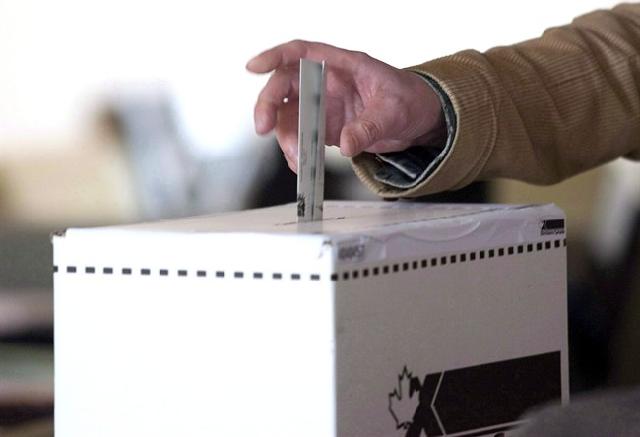
A voter casts a ballot in the 2011 federal election in Toronto on May 2, 2011. THE CANADIAN PRESS/Chris Young
                                     A voter casts a ballot in the 2011 federal election in Toronto on May 2, 2011.                                                            THE CANADIAN PRESS/Chris Young

Strong attachment to Canada
Two Canadians living in the United States launched the constitutional challenge, heard in February, arguing the five-year rule was arbitrary and unreasonable.
Both argued they had only left for educational and employment opportunities and still have a strong attachment to Canada and a stake in its future.
One of the applicants, Montreal-born Jamie Duong, 30, of Ithaca, N.Y., said he was thrilled with Friday’s ruling.
“The decision is good for me, good for democracy, and good for Canadians everywhere,” Duong said.
The other applicant, Toronto-born Gillian Frank, 35, of Princeton, N.J., who served in the Canadian military and was a Governor-General’s Award winner, said the ruling had “strengthened our country’s democracy.”
Both said they looked forward to voting in the next election.
The rule disenfranchising Canadians abroad for more than five years was enacted in 1993 amid debate about the strength of their ties to Canada and their knowledge of domestic politics.
However, the five-year clock reset for those who returned even for short visits until 2007, when Elections Canada began enforcing the requirement for expats to “resume residency” in Canada to regain their right to vote abroad if they left again.
The law exempts some long-term expats — among them members of the Armed Forces and diplomats — who can vote by way of a “special” ballot. As many as 1.4 million other Canadians fall afoul of the law, experts estimate.
In all, expats pay an estimated $6 billion in income taxes to the Canadian treasury, despite using fewer resources than their in-country counterparts.
Toronto lawyer Shaun O’Brien — of Cavalluzzo, Hayes, Shilton, McIntyre and Cornish — said she was delighted the court recognized a fundamental democratic right of the expats, who “care deeply about Canada.”

Friday, March 28, 2014

Democrats Abroad Mexico Dispels Six Voting Myths

banderasnews.com


March 27, 2014
Now US citizens can complete the process of registering and requesting an absentee ballot online - and spread the word to friends and colleagues! - in just two minutes flat at VoteFromAbroad.org.


Puerto Vallarta, Mexico - There are a number of common misconceptions about voting from abroad, which can prevent Americans abroad from exercising their right to vote. Please help us dispel these myths!
Myth #1 "I can't vote. I don't have a US address anymore."
WRONG. Regardless of how long you have lived outside the country, you always retain the right to vote in US Federal elections. Your legal voting address is the last place you resided prior to departing the US. (If you have never lived in the US, many states will allow you to vote using the legal voting address of one of your American parents. Also, depending on state law, it could be that studying or summering in the United States is enough to establish residence. Check with local authorities.)
Myth #2 "I don't need to register. I did it last time."

WRONG. The law has changed. Voters living abroad need to mail in a ballot request every Federal election year. Yes, there are some places, like California, which permit "permanent absentee" registration. But, don't forget that our votes are administered by thousands of different local authorities across the country, each with its own understanding of the law. Better safe than sorry - send a new ballot request every election year! Click HERE for more information.
Myth #3 "They don't even count overseas ballots.
WRONG. Absolutely 100% false. By law, every properly executed absentee ballot must be counted before a final vote count can be certified. However, if the number of outstanding ballots - overseas or otherwise - is smaller than the difference between two candidates, a winner may be called before every last vote has been tallied. Nonetheless, all outstanding ballots must be counted before the election result can be certified.
Myth #4 "One vote can't make a difference."
WRONG. Just look at recent election results. Florida 2000: George W. Bush wins the state - and the presidency - by a margin of 537 votes. Washington 2004: Democrat Christine Gregoire becomes Governor by just 133 votes. Minnesota 2008: Al Franken is finally seated in the Senate with a 312-vote victory.
Myth #5 "If I vote, the IRS will hassle me."
WRONG. Voting in US Federal elections does not affect the determination of tax liability or tax residence. You will not hear from the IRS because you voted in a Federal election, i.e. President, Senate, or House of Representatives. (Note: Voting in state and local elections can potentially affect state and local tax status. You should seek expert advice before voting in state or local elections.)
Myth #6 "Voting from abroad is so complicated."
WRONG. This used to be true! Now, US citizens can complete the process of registering and requesting an absentee ballot - and spread the word to friends and colleagues! - in just two minutes flat at VoteFromAbroad.org.
However, if you are in the Banderas Bay area and would like some local assistance with registering to vote, volunteers will be on hand at either of the Mail Boxes, Etc. locations in Puerto Vallarta (Plaza Molino de Agua or Plaza Peninsula... MBE is moving from Plaza Caracol) or Philo's Bar and Music Club in La Cruz de Huanacaxtle, on Wednesday, April 9th and Friday, April 11th, from 10 am until 2 pm.
With country committees and local chapters in over 80 countries around the world, Democrats Abroad is the official Democratic Party organization for the millions of Americans living outside the United States. For more information about the Costa Banderas Chapter of Democrats Abroad, click HERE. For local assistance, contact Dee Dee Camhi, Chair, at rdcamhi(at)mac.com.