Showing posts with label soccer. Show all posts

Tuesday, October 28, 2014

Sports Tourism a Bonanza for Mazatlán

At least 30 teams were turned away from participating in Copa Mazatlán 2014 due to the lack of playing fields.
This week Mazatlán will receive approximately 12,000 sports tourists for the Copa Mazatlán Dportenis 2014 soccer tournament. The tournament, programmed for October 29 through November 2, is expected to boost the municipality´s overall income by 60 million pesos.
A total of 265 teams of children, teenagers and adults from 25 States in the Republic will take part in the event considered to be the largest soccer tournament in Mexico.
Ernesto Noris Mendoza, Mazatlán Sport representative who is organizing the tournament, said Mazatlán is looking for ways to open the doors and increase sports tourism after many years of (stagnation).
However, he commented, at least 30 teams were turned away from participating in Copa Mazatlán 2014 due to the lack of playing fields. The municipality needs more sports installations and more of superior quality, he said.
Media also reported today that the city is expecting an influx of over 2,000 students who will be attending the Grupo Loc Congress.
Julio Birrueta, director of marketing for a tourism organization, said hotels in the Zona Dorada are reporting up to 70 percent room occupation rates during what is traditionally a slow time for tourism. (from Noroeste)

Tuesday, July 22, 2014

Mexico Did Not Leave 2014 World Cup Empty-Handed


July 22, 2014
Of course, out of 32 teams, there can be only one winner at the end. That's the whole point. Yet, for particular reasons, some teams and their fans were more disappointed than others.


The World Cup, that quadrennial international soccer tournament which draws so much attention worldwide, was held in Brazil from June 12th to July 13th. Thirty-two national teams competed in stadiums in twelve Brazilian cities.

The 32 national teams were (arranged by regional federations through which they qualify):
1. Asian Football Confederation: Iran, South Korea, Japan and Australia
2. African Confederation: Algeria, Cameroon, Ghana, Ivory Coast and Nigeria
3. North America, Central America and Caribbean Federation: Costa Rica, Honduras, Mexico and the United States
4. South American Federation: Argentina, Chile, Colombia, Ecuador, Uruguay, and host nation Brazil
5. European Federation: Belgium, Bosnia and Herzegovina, Croatia, England, France, Germany, Greece, Italy, the Netherlands, Portugal, Russia, Switzerland, and Spain.
For those of you who don't know much about the World Cup (and don't feel bad, I used to didn't either) here's how it works.
At the beginning of the tournament, the 32 national teams are divided into groups of four. In the first round, each team plays the other three teams in the group. At the end of this first round (three games per team), two teams from each group are eliminated and two stay in the tournament. That leaves 16 teams for the second round.
The next round, with the 16 teams, it's single elimination. If a team loses, it's out.
Following the Round of 16 are the quarter-finals, with only eight teams.
By the semi-finals there are four teams left. These teams are paired off, and the two losing teams take on each other for the third-place playoff. The next day, the two winning teams play each other for the World Cup championship.
In this year's World Cup, the final game was Argentina vs. Germany. Team Germany was triumphant, 1-0. This was the team's first World Cup victory since before the union of West Germany and East Germany on October 3rd, 1990. West Germany had won three World Cups before the union, in 1954, 1974 and 1990. (The 1990 World Cup victory was on July 8th, 1990, thus just a few months before unification).
In the past, every single World Cup held in the Western Hemisphere (known in Spanish as the continent of América) had been won by a team from the Western Hemisphere. But Germany broke that tradition, so it's no longer true.
Of course, out of 32 teams, there can be only one winner at the end. That's the whole point. Yet, for particular reasons, some teams and their fans were more disappointed than others.
Spain, the winner of the previous World Cup in 2010, did poorly and was eliminated in the first round.
Brazil, the host country, is the only nation to have played in every single World Cup and the winner of more World Cups (5) than any other country. However, in the quarter-finals, Brazil was demolished 7-1 by Germany. Television coverage showed the faces of devastated Brazilian fans in the stadium. Brazil still had a chance to get third place in the tournament, but its defeat at the hands of the Netherlands team left it in 4th place.
The winner of the Golden Boot award, for the highest scorer of the tournament (not counting penalty shots) went to James Rodriguez of Colombia, who'd scored 6 goals.
The winner of the "Golden Ball" award (considered the most valuable player) was Lionel Messi of Argentina.
The Fair Play trophy was won by Team Colombia.
On the other side of the coin, player Luis Suarez of Uruguay was fined and banned for four months and for nine international matches, for biting (yes, biting!) an opponent during the Uruguay-Italy game. (This was not the first time Suarez had bitten an opponent.)
Argentina, with two World Cup victories in its history, had high hopes, and faced off against Germany for the final game, but was defeated.
As for Mexico, its team played four games in the World Cup:

1. On June 13th, the second day of the World Cup, Mexico faced the West African nation of Cameroon and defeated the Cameroonians 1-0. It was raining throughout the whole Mexico-Cameroon game. The winning (and only) point was scored by Oribe Peralta, a native of the village of La Partida near Torreon in the Laguna region of northern Mexico.
2. Team Mexico faced Brazil on June 17th. The result of this hard-fought game was a 0-0 tie. This felt like a victory for the Mexican fans.
3. On June 23rd, Mexico faced Croatia, and the Mexicans beat the Croatians 3 to 1.
4. On June 29th, in the knockout phase, Mexico faced the Holland team. The Dutch beat Mexico 2 to 1, thus eliminating the Mexicans from the World Cup.
There was a controversial call in that game which was much-discussed afterwards. Mexican player Rafael Marquez received a foul for tripping Dutch player Arjen Robben. Mexican coach Miguel Herrera (El Piojo) disagreed with the penalty, as did many Mexican fans. The slogan No Era Penal ("it wasn't a penalty") erupted on social media, and at least one piñata of Arjen Robben was spotted in Mexico. Looking at video of the game, and the still shots, it appears to me as though Marquez did trip Robben. Robben is known for "diving" or "flopping," exaggerating the gravity of a fall in order to bring a penalty. But it's not just Robben, it's typical of contemporary soccer, a sport in which players exaggerate and over-dramatize. Like it or not, it's a part of the game, in other words!
Thus ended Team Mexico's 2014 World Cup participation.
On the bright side, the Mexican team did not have to hitchhike back to Mexico. They did not exit the tournament empty-handed, nor did any other team.
A lot of money was doled out at the World Cup, as FIFA (the governing board of international soccer) paid out US $576 million. Even the teams who lost in the first round received $8 million dollars apiece, and the winning team (Germany) received $35 million.
The World Cup is held every four years, and the next two sites have already been chosen. The plan is for World Cup 2018 to be held in Russia, and World Cup 2022 in Qatar, a small but prosperous Persian Gulf nation.

Sunday, July 13, 2014

55 Percent of Mexicans Favour Germany in Soccer World Cup

Tomorrow at 1pm local time, Germany will play Argentina in the finals of the 2014 World Cup Soccer match.
According to a survey conducted by Gabinete de Comunicación Estratégica (GCE), 55 percent of Mexican fans will be cheering for the German team and 36 percent for Argentina.
And although Mexico was eliminated from the World Cup, soccer fever has not diminished in the country with 67 of every 100 persons surveyed by GCE saying they will watch tomorrow’s match. Fifty-six percent predicted the match will be decided in the regulation 90 minutes, 17 percent in overtime and 19 percent in a final shootout.
At 2pm local time today Brazil will meet Holland to decide the third place winner. 
(from Noroeste)

Thursday, July 3, 2014

Mexican Team Out, But Not Down

theyucatantimes.com

MÉRIDA, YUCATÁN – Mexico’s world cup journey ended on Sunday in a somewhat controversial 2 – 1 win by Netherlands at the Estadio Castelao in Fortaleza. It was a sad moment for a team which has, in general shown world class performance during the tournament; unfortunately the “curse of the final 16” struck yet again, and by Monday night, the Mexican team was on a flight back to Mexico City.
Mexico fought through the tournament against a backdrop of poor refereeing, bad decisions, and the continuing refusal by FIFA to use the technology at their disposal to ensure games are fair.
Despite the loss in the round of 16 however, Mexico has much to celebrate. The national team, winners of the 2012 Olympic Football Tournament in London has spent the last two years languishing in the doldrums; now however, after months of doubts, the last two weeks have proven that they are still a force to be reckoned with.
Under new manager Miguel Herrera, the team has bounced back, and looked like champions throughout their games in Brazil. Before the tournament, Herrera was frequently criticized for his ‘experimentation’ with various combinations of players right up until the final preparation game; time has shown that he knows what he is doing, and the chatter of criticism soon died away once the real games began.
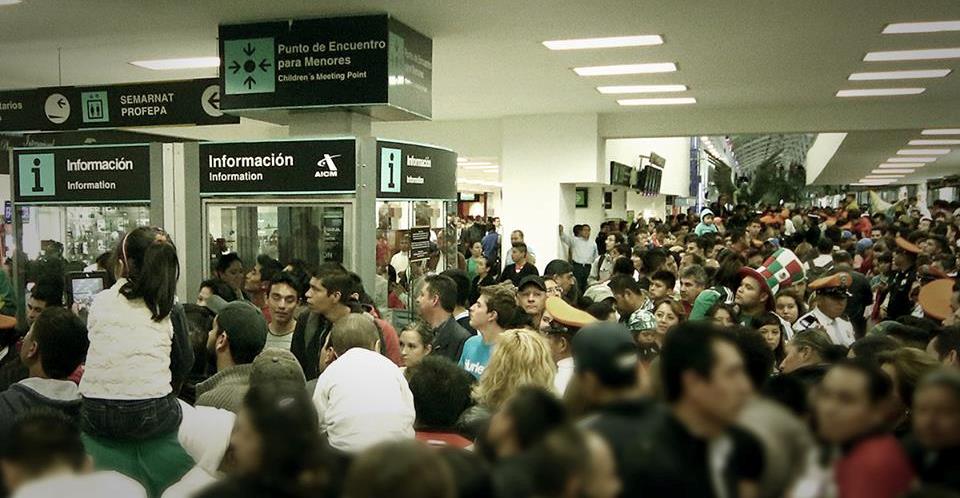
The Mexican team is home today, of course reflecting on what might have been. The rapturous welcome at the airport in Mexico City must have done much for their self-esteem; they can be proud of what they achieved in Brazil, and can look forward to continuing in their rightful place at the top of the region and as a powerful force in world football in tournaments to come.
Crowd awaiting the arrival of the Mexican team today at Mexico City airport
Crowd awaiting the arrival of the Mexican team at Mexico City airport
One final time, for now, let’s all scream “Viva Mexico!!!!!!”
For the schedules of the remaining matches in the upcoming World Cup, see here:http://www.fifa.com/worldcup/index.html

Thursday, June 26, 2014

10 things non-soccer fans need to know about the World Cup

vox.com

Millions of soccer fans around the world have been waiting four years for the 2014 World Cup, which begins on Thursday.
IF YOU DON'T KNOW A TON ABOUT THE SPORT, THIS IS FOR YOU
Millions of American sports fans, however — who have been spending that time watching (American) football, basketball, and baseball — will tune in and be a little confused.
Soccer's definitely becoming more popular in the US, but it's still not quite mainstream. Though there are lots of hardcore American soccer fans, there are many more that will watch the World Cup this summer but don't know a ton about the sport and might be unaware of some of the Beautiful Game's finer points.
If you fall into this latter group, this piece is for you. Here's what you need to know to fake it as a legit soccer fan for the 2014 World Cup.

1. The World Cup is the pinnacle of soccer

102949159
Andres Iniesta holds the trophy after Spain wins the 2010 World Cup. Clive Mason/Getty Images
The world's top soccer players spend most of their time playing for privately-owned teams that represent cities in country-specific leagues — like Manchester United or Real Madrid — in a system that roughly parallels American pro sports.
IT'S AS IF OLYMPIC HOCKEY MATTERED MORE THAN THE STANLEY CUP
But elite players also spend some of their time playing for their home countries' national teams as part of the World Cup, organized by FIFA (theFédération Internationale de Football Association). Unlike American sports, these matches are considered the pinnacle of the sport — not in terms of quality of play, but in terms of the importance assigned to it.
FIFA claims half of humanity tuned into one match or another during the last World Cup. It's as if Olympic hockey mattered more than the Stanley Cup, or the World Baseball Classic was more important than the (poorly named) World Series.
We're about to start the World Cup finals, which take place every four years. 32 national teams compete in a tournament held in one country over the course of about a month, with billions of people watching worldwide. The last one, in 2010, was held in South Africa, and Spain won.
But in between each of these tournaments, there are hundreds of qualifying matches that winnow the field down from 209 national teams to the 32 that make the final tournament.
2014_world_cup_qualification
The 32 blue countries have teams in the World Cup finals. Yellow countries do not. (Black countries didn't enter teams, and grey ones aren't FIFA members.) Wikimedia commons
Last December, the 32 teams that made it into this years' finals were arranged into eight groups of four that are supposedly of even quality, based on a combination of rankings, geography, and random chance.

2. The World Cup finals are a multi-stage tournament

The month-long tournament is divided into two stages. First, as part of the group stage, each team plays the three other countries in its group.
IN THE GROUP STAGE, EACH TEAM PLAYS THE OTHER THREE IN ITS GROUP
For example, the US was in Group G, with Ghana, Portugal, and Germany. They played each of these teams once (on June 16, 22, and 26, respectively), and the three other teams played each other once as well.
In this stage, a win counts for three points, a draw counts for one point, and a loss is zero points. When all these matches finished on June 26, the two teams with the most points from each group advanced. In Group G, that was Germany and the US.
On June 28, the winning 16 teams will enter a single-elimination tournament, called the knockout stage. It works pretty much like the NCAA tournament — 16 teams get cut down to 8, then 4, then 2 teams as each round progresses. There are no draws: tie matches are followed by extra time (i.e. overtime), then if they're still tied, by a shootout. The championship will be on July 13.
Update: Fourteen teams (Ghana, Portugal, Spain, Ecuador, Honduras, England, Australia, Bosnia, Croatia, Italy, Cameroon, Japan, Iran, and the Ivory Coast) have been eliminated. Fifteen teams (Germany, the US, Brazil, France, Mexico, the Netherlands, Chile, Costa Rica, Uruguay, Switzerland, Argentina, Nigeria, Belgium, Columbia, and Greece) have clinched spots in the knockout stage. Algeria, Russia, and South Korea are battling for the final spot.

3. The US team was in the "group of death" — but made it out

184716630
The US men's national team poses before an October 23 match against Panama. RODRIGO ARANGUA/AFP/Getty Images
Every World Cup, there are unusually strong groups stocked with solid teams, nicknamed the "groups of death." Coming into the tournament this year, many felt Group G — which featured the US, Germany, Portugal, and Ghana — was it.
But the US team's dramatic victory in game 1 against Ghana, paired with a draw against Portugal, gave them just enough points to make it out of Group G, and make it into the knockout stage for the second straight World Cup.
Unlike in many other team sports, the US team has never been a world soccer power, and only has a single knockout round win since 1930. They'll face a tough test right off the bat, likely playing Belgium in their next match, on July 1. The last time the two teams met, Belgium won 4-2.

4. Brazil, Argentina, and Germany are three of the favorites

170631464
Neymar, Brazil's star forward, celebrates a goal. Dean Mouhtaropoulos/Getty Images
Coming into the World Cup, Spain — winner of the 2010 World Cup and FIFA's number one ranked team — was considered one of the teams likeliest to win this year. But the team has already been eliminated after upset losses to Chile and the Netherlands, changing the complexion of the tournament before the knockout rounds.
The current favorite is probably Brazil. The third-ranked team in the world coming in to the World Cup, Brazil is also enjoying the benefits of playing at home: the team hosting the tournament has won six of 19 World Cups, and has made it to the knockout stage every time except once. Brazil has also won five World Cups — more than any other country — and is looking to erase the disappointment of the last time the country hosted the tournament, in 1950, when the squad only needed a draw in the final against Uruguay to win the title, but lost.
Other strong contenders include Argentina — a team that features forward Lionel Messi, one of the world's top goal scorers, and has already clinched a spot in the knockout stage after wins over Bosnia and Iran — and Germany, who was ranked second in the world heading in to the tournament.
Note: This article, originally written before the World Cup, first named Brazil and Spain as the favorites. It's since been updated.

5. Soccer is a complex game

Screen_shot_2014-06-10_at_9.33.15_am
The 4-2-3-1 formation, increasingly popular in recent years. Wikimedia commons
To a casual viewer, soccer might seem pretty straightforward: you have two teams of eleven players on a field (called a pitch), both trying to put a spherical ball into the other team's goal. They can use any part of their body besides their arms or hands to do so, except the goalie (called a keeper), who can use his hands as long as he's within a box in front of his own net.
The nuances of the game, though, are more complicated than you might expect. Among the important rules to know:
  • An offensive player is offside if he is in the attacking half of the field, doesn't have the ball, and goes behind the second-farthest back defender (including the keeper). If this player gets involved in the play — say, by being passed the ball — it's a violation, and the other teams gets a free kick. This complex rule is intended to prevent offensive players from just sitting by the net, waiting for the ball.
  • yellow card is shown to a player after he commits a misconduct, a type of foul. If he commits a second misconduct, a red card is shown, and he's ejected — forcing his team to play one man down for the rest of the match.
  • throw-in occurs when the ball is kicked out of bounds along one of the side lines. When it goes out the end line, a goal kick occurs if it was last touched by an offensive player, and a corner kick occurs if it was last touched by a defensive player or the keeper.
  • The match lasts 90 minutes (with two 45-minute halves), and the clock never stops. Not for goals, injuries, or any time-outs. Instead, referees add stoppage time to the end of the match to cover the time used up on substitutions and goal celebrations.
  • Each team is allowed three substitutions over the course of a match. For the World Cup, rosters are limited to 23 players: 11 starters and 12 subs.
A team is made up of ten defenders, midfielders, and forwards — with varying numbers of each for strategic reasons — plus one keeper. Different coaches use all sorts of different numbers and formations of the first three: currently, the 4-2-3-1 formation (four defenders, two defensive midfielders, three attacking midfielders, and a forward) is especially popular.
But apart from their formations, teams have radically different strategies and styles. Germany has long been known for organization and efficiency, Spain makes many short, high-percentage passes, Argentina has an explosive offense led by Lionel Messi, and Brazil uses speed to press aggressively. Like any sport, the strategy of soccer goes very deep.

6. There are millions of dollars at stake

456895809
Beira Rio stadium, in Porto Alegre, one of seven new or heavily refurbished stadiums built for the World Cup. Shaun Botterill/Getty Images
To an American, this whole tournament seems pretty Olympic-esque. So it might come as a surprise that there are actually payouts given to winning teams: FIFA gives out a total of $576 million, with $35 million going to the champions, $25 million to the runners up, and various amounts to every other team down to $8 million for those eliminated in the group stage.
FIFA IS PROJECTED TO TAKE IN $4 BILLION
Like the Olympics, though, the organizing group rakes in most of the money. Though FIFA is spending an estimated $2 billion on the event, they're projected to take in a record $4 billion from ticket sales, corporate sponsorships, and other revenue streams.
These profits are related to the culture of corruption within FIFA, which has been getting attention from everyone from the New York Times to John Oliver in recent days. Part of the problem is the secret vote used to award World Cup sites, which allegedly led to Qatari officials paying multimillion-dollar bribes to FIFA in exchange for the 2022 World Cup. That scandal doesn't directly involve this year's World Cup, but it's added to the aura of corruption surrounding FIFA and casts a shadow over the event.

7. Many Brazilians are protesting the World Cup

170953234
Students protest in Brasilia. EVARISTO SA/AFP/Getty Images
Brazil absolutely loves soccer. But the Brazilian government has spent an estimated $14 billion preparing for the tournament, building seven gleaming new or fully refurbished stadiums around the country, and upgrading airports, roads, and light rail systems. It is paying $900 million for security forces alone.
GIVEN THAT NEARLY 16 PERCENT OF THE COUNTRY LIVES BELOW THE POVERTY LINE, MANY BRAZILIANS ARE PROTESTING THE $14 BILLION SPENT ON THE WORLD CUP
At the same time, nearly 16 percent of the country lives below the poverty line, basic infrastructure like sewer lines and sidewalks aren't available to many people, and economic growth has slowed in recent years. That's why many Brazilians are questioning these investments — especially given FIFA's projected profits from the event. In a recent poll, 61 percent of Brazilians said hosting the event was bad for the country's economy.
Additionally, nine construction workers died during the course of building the stadiums, and about 250,000 people have been displaced from urban favelas during the lead-up to the event. Making matters worse is the fact that Rio de Janeiro is also hosting the 2016 Olympics, which will involve further construction of lavish facilities for elites and foreign athletes.
Consequently, protests, strikes, and riots have erupted in many corners of Brazil as the event draws near. Most recently, a subway strike in São Paulo has disrupted transportation in the mega city and threatened instability with matches just a few days away.

8. The matches are spread thousands of miles apart

You might imagine the World Cup to be a geographically compact event, like the Olympics. But the 12 stadiums are spread widely across Brazil, a country nearly as large as the US.
As a result, the tournament will entail long-distance travel for the teams. From the US team's first match, in Natal, they'll fly about 1,700 miles to Manaus, for their second match.
Screen_shot_2014-06-09_at_5.21.52_pm
The 12 sites of the 2014 World Cup. Wikimedia commons
This is the second World Cup to be hosted in Brazil, and the stadiums are spread more evenly than in 1950, with more northern and inland sites involved.
In between matches, teams will stay at self-selected base camps. The vast majority are staying at either Rio de Janeiro or São Paulo, with the US at the latter.

9. Many teams ban their players from having sex during the World Cup

171663279
The Spain team celebrates a 2013 win, perhaps a result of abstinence during tournament play. Robert Cianflone/Getty Images
Among the stranger things to know about the event: some coaches restrict their players' sex lives during the month of play due to the belief that excessive sex will impede their performance on the field.
Players on Spain, Germany, Chile's teams aren't allowed to have sex at all, while Brazil's players are permitted to have "normal sex" as long as it's not "acrobatic," and France's are also allowed to have sex as long as it doesn't last all night.

10. You can watch on the matches on ESPN and Univision

In the US, the 64 matches will be split between ESPN (43 matches), ESPN2 (10 matches) and its parent network ABC (10 matches).  ESPN will also make every game available through its WatchESPN website and apps, but you need to be a subscriber to one of 14 cable companies access them. You can find the full listings here.
However, if you don't pay for cable but still want to watch, the matches will also be broadcast in Spanish on Univision and streamed online. Quartz has a nice list of other options for figuring out how to watch for free online.

Friday, June 13, 2014

It's on: The World (Cup) comes to Brazil for soccer supremacy

startribune.com
by: MICHAEL RAND , Star Tribune
June 12, 2014


The World Cup features eight groups of four teams each. The teams in each group play each other once, with the top two from each group advancing to the round of 16 knockout stage. Here is a look at each group.
Group A
Brazil, Croatia, Mexico, Cameroon
Overview: The match between host Brazil and Croatia will open the World Cup on Thursday in Sao Paulo. The five-time champions are boosted by their boisterous fans and confident following the Confederations Cup victory last year, but Brazil will be looking to do better than it did at the past two World Cups, when it was eliminated in the quarterfinals. After barely qualifying, Mexico hopes to finally get past the second round in Brazil. Cameroon hasn’t advanced past the group stage since 1990s. Croatia won’t have forward Mario Mandzukic, who was red-carded in a decisive qualifier against Iceland.
Player to watch
Samuel Eto’o, Cameroon
After reconsidering a decision to retire, Eto’o will be carrying Cameroon’s hopes of a surprising performance in Brazil. The striker, who will be 33 in Brazil, has been playing well with Chelsea.
Group B
Spain, Netherlands, Chile, Australia
Overview: Spain lost its opening match at the World Cup four years ago, but went on to beat the Netherlands 3-0 in the final. Those same two teams meet in one of the most anticipated opening matches. Spain has not lost a step as it vies to win a fourth major tournament in a row with a core squad likely playing its final World Cup. Netherlands is always a contender but was a flop at Euro 2012. The Dutch went unbeaten in World Cup qualifying. Chile is lurking, waiting to take advantage of any slip-up by Spain or the Netherlands. Australia has an inexperienced squad that is being groomed for the 2018 World Cup.
Player to watch
Robin van Persie, Netherlands
He must seize the opportunity after the Manchester United striker has scored only once at the past two major tournaments, the 2010 World Cup and Euro 2012.
Group C
Colombia, Greece, Japan, Ivory Coast
Overview: After the draw in December, Colombia was made an early favorite to advance from Group C. But that was before striker Radamel Falcao damaged ligaments in his left knee and was ruled out of the Cup. Greece coach Fernando Santos will step down after the Cup, but says he’s glad to help lift the country’s spirits after it endured four years of severe financial crisis. Japan will be looking for Keisuke Honda to provide a spark in Brazil, but the bleach-haired forward has had an unsettling time at AC Milan since joining this year from CSKA Moscow. Didier Drogba remains at the center of Ivory Coast’s hopes, despite turning 36 last month.
Player to watch
Giorgos Karagounis, Greece
He remains motivator-in-chief at age 37, playing in eight qualifiers and both playoffs to reach a record 132 appearances for the national team.
Group D
Italy, England, Uruguay, Costa Rica
Overview: With three former champions in Italy, England and Uruguay plus unpredictable Costa Rica, Group D is among the World Cup’s toughest. As European Championship runner-up, Italy is the favorite. But Uruguay is the South American champion and few teams can match its strength at forward, with Luis Suarez and Edinson Cavani leading the way. England is hoping to carry over its form from an undefeated qualifying campaign, but it hasn’t gotten past the quarterfinals in its past four World Cups and star player Wayne Rooney failed to score in the past two tournaments. Costa Rica has pulled off surprises before and conceded only seven goals in 10 matches of the final qualifying phase.
Player to watch
Mario Balotelli, Italy
Italy’s intentions will likely depend on Balotelli, a talented forward whose mood swings often get him into trouble.
Group E
France, Switzerland, Ecuador, Honduras
Overview: France will head to the World Cup as the favorite in Group E despite a back injury to star Franck Ribery and strong competition from well-organized Switzerland. France coach Didier Deschamps is reluctant to talk up his team’s chances at the World Cup because he still thinks his players lack consistency. The traumatic exit from the last World Cup — where the players went on strike and failed to even win a game — is still etched in their memories. Switzerland coach Ottmar Hitzfeld is happy for France to have the pressure of being group favorite. The Swiss and French will meet June 20 in Salvador in a match that is likely to decide the group winner. Ecuador and Honduras have some star power, but both are heavy underdogs to advance.
Player to watch
Antonio Valencia, Ecuador
The Manchester United winger is Ecuador’s best-known player and could carry any hopes for an upset on his shoulders.
Group F
Argentina, Nigeria, Bosnia, Iran
Overview: Barring a major upset at the World Cup, Argentina will finish at the top of Group F and let the other three teams compete for second place. Lionel Messi, Gonzalo Higuain, Angel Di Maria and Sergio Aguero — Argentina coach Alejandro Sabella has more attacking talent than he can fit into the lineup. By comparison, the defense doesn’t look quite as impressive. Still, concerns about Argentina’s vulnerability in the back shouldn’t be exaggerated. The team conceded only 15 goals in 16 qualifying matches. Of the 32 countries in the tournament, only Bosnia is making its first World Cup appearance. Of the 30 goals the Iranians scored in qualifying, nine came on corner kicks or free kicks.
Player to watch
Lionel Messi, Argentina
The list of accomplishments for Messi, who will turn 27 during the Cup, is staggering. Suffice to say he is considered by many to be the best player in the world and is already in the conversation as one of the all-time greats.
Group G
United States, Germany, Portugal, Ghana
Overview: The so-called “Group of Death” will provide a challenge to all. Germany is always among the highest-ranked teams in the world has a winning record against all three group opponents. Ghana reached the quarterfinals four years ago — beating the United States in the process. If the U.S. is to advance to the knockout stage this time, a good showing in its opener Monday against Ghana will be imperative. Coach Jurgen Klinsmann has taken heat heading into the Cup for leaving veteran Landon Donovan off the squad. Portugal might not be much beyond Cristiano Ronaldo, but sometimes he is enough. Portugal also should be feeling more at home in Brazil than its opponents. The two countries share the language and Portugal should have plenty of local supporters.
Player to watch
Cristiano Ronaldo, Portugal
The winner of the Ballon d’Or as the best player in the world and a record scorer in the Champions League, Ronaldo gives Portugal a big weapon in the attack.
Group H
Belgium, Russia, South Korea, Algeria
Overview: Group H might lack the appeal of teams such as Brazil and Germany and stars such as Messi and Ronaldo, but with Belgium players Vincent Kompany and Eden Hazard, and Russia coach Fabio Capello, the group shouldn’t be disregarded. Capello got Russia to Brazil by winning a group which included Portugal, and that has given him enough confidence to keep his eye on the second round. Belgium might still be too young to reap the rewards of its talent, but there will be no waiting once they get to Brazil. Even if Group H seems easy, the rest of the way in the tournament will be anything but. After the group matches, the road will lead to the top teams from Group G, arguably the toughest of the tournament.
Player to watch
Eden Hazard, Belgium
The Chelsea playmaker has seen his stock rise during a standout season with Chelsea and an easy first-round group can do wonders for a player looking for recognition on the biggest stage.