Showing posts with label archeology. Show all posts

Wednesday, September 24, 2014

Archaeologists found traces of 2,500-year-old chocolate in the Yucatan Peninsula

theyucatantimes.com

Back in 2012,  archaeologists found ancient chocolate residue on a plate, rather than a cup.
Experts have long thought cacao beans and pods were mainly used in pre-Hispanic cultures as a beverage, made either by crushing the beans and mixing them with liquids or fermenting the pulp that surrounds the beans in the pod. Such a drink was believed to have been reserved for the elite.
But the discovery announced 2 years ago by Mexico’s National Institute of Anthropology and History expands the envelope of how chocolate may have been used in ancient Mexico. It would also suggest that there may be ancient roots for traditional dishes eaten in today’s Mexico, such as mole, the chocolate-based sauce often served with meats.
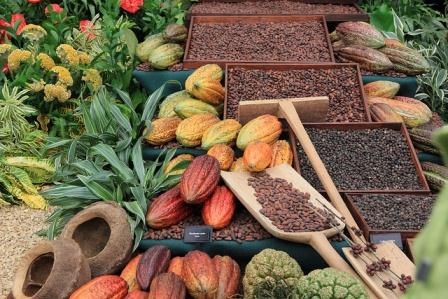
Cacao Beans and Pods
This is the first time it has been found on a plate used for serving food,” archaeologist Tomas Gallareta said. “It is unlikely that it was ground there (on the plate), because for that they probably used metates (grinding stones).”
The traces of chemical substances considered “markers” for chocolate were found on fragments of plates uncovered at the Paso del Macho archaeological site in Yucatan in 2001.
The fragments were later subjected to tests with the help of experts at Millsaps College in Jackson, Mississippi, as part of a joint project. The tests revealed a “ratio of theobromine and caffeine compounds that provide a strong indicator of cacao usage”, according to a statement by the university. “These are certainly interesting results,” John Henderson, a Cornell University professor of Anthropology and one of the foremost experts on ancient chocolate, said.
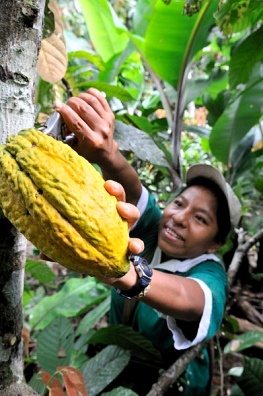
Cacao Harvest in the Yucatan
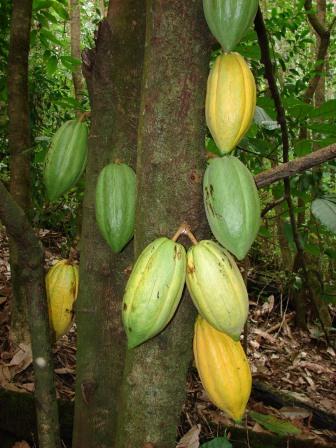

cacao4
Cacao Plant


Prof Henderson, who was not involved in the Paso del Macho project, said “the presence of cacao residues on plates is even more interesting … the important thing is that it was on flat serving vessels and so presented or served in some other way than as a beverage”. “I think their inference that cacao was being used in a sauce is likely correct, though I can imagine other possibilities,” he added, citing possibilities like “addition to a beverage (cacao-based or other) as a condiment or garnish”.
The plate fragments date to about 500 BC and are not the oldest chocolate traces found in Mexico. Beverage vessels found in excavations of Gulf coast sites of the Olmec culture, to the west of the Yucatan, and other sites in Chiapas, to the south, have yielded traces around 1,000 years older.
But it does extend the roots of Mexican cuisine, and the importance of chocolate, further back into the past. “This indicates that the pre-Hispanic Maya may have eaten foods with cacao sauce, similar to mole,” the anthropology institute said.

Wednesday, August 27, 2014

2 new Maya cities in Mexico could connect the empire's north and south regions

startribune.com
  • by: Associated Press 
  •  
  • August 26, 2014 - 6:55 PM
  •  
MEXICO CITY — Two lost Maya cities recently uncovered by an international team of scientists in Mexico could help decipher the story of the empire's early capitals to the south that were eventually abandoned for large cities on the Yucatan peninsula.
Both discoveries are in the southeastern part of the Gulf state of Campeche on the Yucatan peninsula.
The first site, known as Tamchen, features plazas, palatial buildings and a 45-foot-tall (15-meter-tall) pyramid. Its name means "deep well," and comes from a collection of underground water tanks.
The second, Lagunita, was discovered 40 years ago by American researcher Eric von Euw. His sketches of various monuments, including a facade resembling the jaws of a reptile, were never published, and the location of the site was lost. Scientists used his drawings and photographs to relocate the ruins.
"It's amazing that we're still discovering new sites," said Lisa Lucero, a University of Illinois anthropologist, noting that the cities are located in an area once considered a buffer or a no-man's land. "We're starting to fill in the gaps ... and they're more densely populated with centers and farmsteads than we thought."
The buildings indicated Lagunita was a place of regional importance, according to a statement by Mexico's National Institute for Anthropology and History. The discoveries will help archaeologists study the cultural and political histories of an area known as the Central Lowlands of the Maya region, now a remote part of the Calakmul Biosphere Reserve, the statement says.
Researchers have found unique characteristics in the lost cities, including the shapes of some altars and the forms of hieroglyphics.
Lucero said the new findings could better connect the Maya centers of the south, such as Palenque in Chiapas and Tikal in Guatemala, which were abandoned, with the later northern centers such as Chichen Itza.

Sunday, May 25, 2014

19th Century Aqueduct Found Hidden Under Scrub in Northern Mexico

laht.com

MEXICO CITY – An aqueduct 110 meters (360 feet) long and 5 meters (16 feet) high, built in the mid-19th century and which remained hidden under vegetation for many years, was discovered in the northern Mexican state of Nuevo Leon, the national archaeological authority said.

The discovery was made during the work of clearing the land, whose owner reported it to the Linares municipal government, which in turn asked the National Institute of Anthropology and History (INAH) to get involved and make an evaluation of it.

Architect Benjamin Valdez Fernandez of INAH in Nuevo Leon, leader in the task of authenticating the discovery, said that “it is a very important find.”

“We have nothing similar in Nuevo Leon in terms of the dimensions and construction” of this well preserved hydraulic work that has 33 arches of the Tudor type, ogive,” he said.

The aqueduct begins at ground level like an irrigation ditch, but as the land begins to slope downward, a series of arches is formed to support the channel that carried water to the end, where there was a waterwheel and a sugarcane mill, INAH said.

Valdez said it is believed to have been built around 1860 due to the fine sandstone construction and smooth finish of its walls.

“A very interesting feature of the construction, which we believe to have been done by Jesuits, is it 33 arches, a very important number in religious imagery. According to the Catholic faith, Jesus died on the cross at age 33, and 33 is the number of years that David reigned over the ancient Kingdom of Israel,” the researcher said.

As for the state of the aqueduct, he said that just a few stones have fallen from three of the 33 arches, which need major restoration, while the rest of the construction requires only maintenance.