Showing posts with label cusine. Show all posts

Tuesday, December 2, 2014

5 Reasons Mexico Can Be Better Outside of a Resort

travelpulse.com

5 Reasons Mexico Can Be Better Outside of a Resort
Mexico is a fantastic country with delicious cuisine, friendly people and some of the world's most amazing historical sites. People love going on vacation to Mexico, and why wouldn't they? A resort allows you to enjoy a beautiful beach, have waiters refill your margarita before you even notice it's empty, and enjoy a selection of 10 different international restaurants all without even leaving the resort!
But what if we were to tell you that your vacation could be even better? Try venturing outside of the all-inclusives and experience the real Mexico!
Here are five reasons why Mexico can be even better outside of the resort:
1. The Cost
With prices like $1500 / week for a five-star, all-inclusive holiday, you may think that you could never enjoy Mexico for less if you did it independently. But believe us, you can. Mexico is a country of incredible value and you could easily spend three weeks here, staying in an apartment, eating local food and drinking at local bars, and you wouldn't spend more than $1,500 in three weeks!
But, you don't have to stay in an apartment or a hotel, you can still stay in your resort and experience Mexico. Just hop on a local bus or taxi and take a day-trip to a nearby town. You'll love the vibe of the local life in this incredible country.

Money Belt
2. Meeting Local People
One of the most fascinating aspects of travel is having the opportunity to meet and mingle with the local people in whatever countries you visit. It's amazing when you get the opportunity to learn about the culture, day-to-day life, and beliefs first hand, from a new local friend.
Of course, the employees at your resort will be Mexican, and it's great to be able to sit and chat with them for a while, but they're busy and you don't often get into deep conversations with them. mexican people
If you have the opportunity to meet Mexicans at a bar, at a restaurant or on the streets, outside of a work environment, it will be easier to forge lasting friendships and really get to know them. Who knows, you may even get invited into their homes... a prospect that is less likely if you're staying at a resort.
3. Tasting Real Mexican Food
Of course your resort will have amazing Mexican restaurants on-site, but let's be honest. How many meals do you actually end up eating there? With so many amazing international restaurants around, you may just end up eating every type of food except Mexican!
mexican food
If you stay in a small local town like Valladolid in the Yucatan, you'll have more options for Mexican food than you could dream of. You'll learn about local specialties, ingredients and preparation methods. Best of all, you'll probably be sharing the restaurant with mostly locals, which is a great way to mingle and make new Mexican friends.
4. Learning Some Spanish
This may not be a top priority for you when you're planning your vacation to Mexico, but it can be a lot of fun to learn Spanish while you're there! If you take a tip from No. 1 in this post, you may be hanging around for three weeks or more. That means you'll have plenty of time to learn and practice some of the local language. Mexicans are always friendly to tourists, but they love it whengringos take the time to learn a bit of their native tongue. Not only will you enjoy the new skill, but your Mexican friends will appreciate it.
5. Being IN Mexico:
Of course if you go to Mexico and stay in a resort, you'll have been to Mexico... but venture away from your gated all-inclusive community and head into the cities to get a real feel for this amazing nation, its unique culture and its welcoming people. There's nothing like walking down a back road in quiet village, or strolling through the city centro in the late afternoon. Mexico is a great place to be, so get out there and see it!
valladolid mexico
Photo: Beautiful Valladolid town in the Yucatan State
While staying in a resort is a fun experience and the ultimate way to relax on your holiday, you may want to consider this alternative way of travelling in Mexico. Even if you still stay in a resort, you can enhance your trip by leaving the grounds once in a while and taking a local bus into town.
Mexico is out there, waiting to be explored, and despite what the news says, it's safe. You won't be venturing into dangerous border towns, or walking down dark alleys at night, so you can be sure that in major tourist towns like Cancun, Puerto Vallarta and Playa del Carmen, you'll have no issues. So why not head out into the real Mexico? Give it a try to see what it's like.

Wednesday, September 24, 2014

Archaeologists found traces of 2,500-year-old chocolate in the Yucatan Peninsula

theyucatantimes.com

Back in 2012,  archaeologists found ancient chocolate residue on a plate, rather than a cup.
Experts have long thought cacao beans and pods were mainly used in pre-Hispanic cultures as a beverage, made either by crushing the beans and mixing them with liquids or fermenting the pulp that surrounds the beans in the pod. Such a drink was believed to have been reserved for the elite.
But the discovery announced 2 years ago by Mexico’s National Institute of Anthropology and History expands the envelope of how chocolate may have been used in ancient Mexico. It would also suggest that there may be ancient roots for traditional dishes eaten in today’s Mexico, such as mole, the chocolate-based sauce often served with meats.
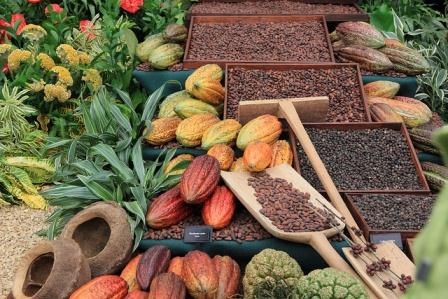
Cacao Beans and Pods
This is the first time it has been found on a plate used for serving food,” archaeologist Tomas Gallareta said. “It is unlikely that it was ground there (on the plate), because for that they probably used metates (grinding stones).”
The traces of chemical substances considered “markers” for chocolate were found on fragments of plates uncovered at the Paso del Macho archaeological site in Yucatan in 2001.
The fragments were later subjected to tests with the help of experts at Millsaps College in Jackson, Mississippi, as part of a joint project. The tests revealed a “ratio of theobromine and caffeine compounds that provide a strong indicator of cacao usage”, according to a statement by the university. “These are certainly interesting results,” John Henderson, a Cornell University professor of Anthropology and one of the foremost experts on ancient chocolate, said.
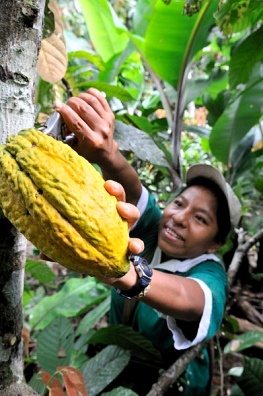
Cacao Harvest in the Yucatan

cacao4
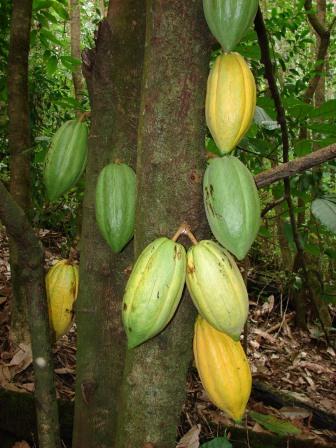
Cacao Plant


Prof Henderson, who was not involved in the Paso del Macho project, said “the presence of cacao residues on plates is even more interesting … the important thing is that it was on flat serving vessels and so presented or served in some other way than as a beverage”. “I think their inference that cacao was being used in a sauce is likely correct, though I can imagine other possibilities,” he added, citing possibilities like “addition to a beverage (cacao-based or other) as a condiment or garnish”.
The plate fragments date to about 500 BC and are not the oldest chocolate traces found in Mexico. Beverage vessels found in excavations of Gulf coast sites of the Olmec culture, to the west of the Yucatan, and other sites in Chiapas, to the south, have yielded traces around 1,000 years older.
But it does extend the roots of Mexican cuisine, and the importance of chocolate, further back into the past. “This indicates that the pre-Hispanic Maya may have eaten foods with cacao sauce, similar to mole,” the anthropology institute said.

Friday, July 4, 2014

Canirac Seeks Cultural Heritage Designation for Sinaloa Cuisine

Gastronomically speaking, Sinaloa has everything to obtain the recognition.
The national chamber of the Industria Restaurantera y Alimentos Condimentados (Canirac) will fight to have Sinaloa cuisine recognized as an intangible cultural heritage by the United Nations Educational, Scientific and Cultural Organization (Unesco), said Ricardo Velarde Cárdenas, president of the restaurant organization.
The project is an offshoot of the recognition of Mexican food internationally, in particular diverse dishes from specific States. Velarde Cárdenas wants to include Sinaloa in that category given, he says, the wide culinary tradition and original cuisine of Sinaloa.
He told media the national Canirac delegation is in agreement with the proposal and it will be at the center of discussions at the next meeting of national representatives to take place in Mazatlán in September or October this year.
Gastronomically speaking, Velarde Cárdenas pointed out Sinaloa has everything to obtain the recognition but it will take work and coordination. The Sinaloa Secretary of Tourism has already made some advances in the process and would be interested in taking up the project, he added.
In the meantime, the organization is continuing with its plan to establish a gastronomy route in cities along the Northern Economic Corridor.
Canirac Mazatlán will participate in Durango city´s national fair beginning July 18 and ending August 10, where it will display the best of Mazatlán cuisine, principally dishes based on seafood, to entice tourists to vacation in the port. Velarde Cárdenas said they expect 20 or 30 Mazatlán restaurants to participate. 
(from Noroeste)

Wednesday, June 25, 2014

10 Things You Probably Didn’t Know About Mexican Food

BY JEANNETTE | APRIL 6, 2012

marcussamuelsson.com

Photo: rdpeyton
By: Justin Chan
The Wall Street Journal recently paid tribute to the power of Mexican food in America by running an article that lists several fun facts that you might find interesting (you can find them below). The piece was published in concurrence with Taco Bell’s 50th anniversary last month.  While Taco Bell cannot be classified as traditional Mexican food, it is undoubtedly a fast food version that Americans, particularly the hungry and on-a-budget college students, seem to like.
Taco Bell, in fact, is one of many chain restaurants that helped put Mexican cuisine on the map.Chipotle Mexican Grill is also gaining prominence, as more and more Americans try to satiate their growing desire for the Central American cookery. Although such chains have made Mexican cuisine trendy, the roots of Mexican food in the United States can be traced as far back as the 1800s. Tex-Mex food, for instance, originated during that period, and the term “Tex-Mex” was first coined in 1875, when the Texas Mexican Railway was chartered. Since its creation, Tex-Mex food has incorporated influences from Spain, Mexico and South Texas and has spread across the country. Although it is generally described as a regional American cuisine, it was created by Mexican Americans who borrowed largely from the Mexican food culture.
Here are some other facts you probably didn’t know:
1. Taco Bell may have popularized tacos, but the history of tacos dates back to the Mexican Revolution, when refugees brought the food to the United States.
2. Tortillas were once canned. During the 1980s, many Americans could only find canned tortillas, a creation that can be attributed to El Paso’s George N. Ashley. Ashley first sold the product in 1938 and had some success, but his creation can no longer be found on supermarket shelves today.
3. Fajitas were made famous by Ninfa’s, a restaurant managed by Rio Grande Valley native Ninfa Rodriguez Laurenzo. In fact, the dish was so appealing that chains like El Torito and Chi-Chi’s sent spies to steal the recipe.
4. The invention of the nacho can be credited to Ignacio Anaya, a chef in Piedras Negras, Mexico. Anaya initially made the snack for military housewives who went shopping on the holidays. The concept, however, gained popularity in the late 1970s, when Frank Liberto, a concessionaire in San Antonio, decided to sell nachos at Arlington Stadium.
5. Disneyland played a role in the invention of Doritos. In the early 1960s, Mexican workers at the theme park’s restaurant fried leftover tortillas and added flavoring to help create the now-popular brand.
6. America’s first Mexican-food celebrity was not Mexican. A man by the name of Buffalo Bill Cody earned the unique recognition after he started a Mexican restaurant outside of Madison Square Garden in 1886.
7. The first official American fans of Mexican food were members of the military. In 1879, the War Department agreed to allow San Antonio canners to feed its soldiers chile con carne.
8. The earliest margaritas were made in a rigged soft-serve ice-cream machine. In 1971, Mariano Martinez used the machine to blend a prefabricated mix stored in a Spackle bucket and create the beverage.
9. In 1966, two New York housewives operated an early version of the taco truck. Although the truck did not have a full kitchen, it was available for catering.
10. Some accredit the popularity of Mexican cuisine to the 1893 World’s Columbian Exposition in Chicago. During the fair, tamaleros from San Francisco would roam the area and promote their food.

Friday, May 30, 2014

Tourism needs cultural promotion

THE NEWS
Even though Mexico has a rich culture and a vast and diverse culinary tradition, only 3 percent of foreign tourists come to the country with the objective of learning more about this the nation’s cultural and culinary heritage, hotel entrepreneur Rafael García González said Thursday.
During acrimony in which García González announced that he would be putting his hat in the ring for president of Mexican Association of Hotels and Motels (AMHM), he said that there is a need for a more aggressive campaign to instill among visitors a desire to learn about Mexican culture.
He pointed out that Mexico ranks sixth worldwide in the number of World Heritage Sites and that Mexican cuisine has been recognized by UNESCO as an intangible cultural heritage of all humanity.
Mexico has the most important hotel infrastructure in Latin America.
According to García González, the size and value of Mexican hotels puts it in an excellent position to compete for the global cultural tourism market.

Monday, December 16, 2013

Mexican cuisine is in renaissance

Monday, 16 December 2013 00:10 
THE NEWS

Mexico’s traditional food has attracted more domestic and international interest since it was included on the UNESCO Intangible Cultural Heritage list in 2010, Catherine Good, a researcher with the National Institute of Anthropology and History (INAH), said on Sunday.

Good’s comments were made at the “Sabores de Nuestro Saber” (“Flavors of Our Knowledge”) contest in Bogotá, which awards research into the culinary traditions of Latin America.

“The impact has been very big,” she said. “Now the whole world wants to know more about traditional culinary experiences at the personal, family and community level.”

According to Good, since its 2010 recognition by UNESCO, there is now a renewed interest in traditional food among Mexico’s urban population, who increasingly want to learn about how the ingredients they use every day are produced.

“There’s a great appreciation for the sophistication of cooking in rural areas, because it’s part of a pre-Hispanic cultural relationship that also incorporates elements from the colonial period,” she said. “Traditional cooking is a creative process in Mexican culture.”

She went on to say that there has been a rise in the number of students at culinary schools who specialize in Mexican food, including professionals in the tourism and communication sectors, which she added shows sufficient interest to deepen research in the country’s culinary traditions.

“In Mexico, chef training is traditionally designed to teach Italian, French, Chinese or Japanese cuisine, without showing interest in traditional Mexican food. This has changed,” she said, adding that Mexican cuisine is valued by all social sectors of the country, without political, ideological and religious distinctions.

Beyond an increase in domestic interest in Mexico’s culinary traditions, Good said that there is also increased interest abroad in the country’s food, which is usually misrepresented by Tex-Mex cooking instead of authentic Mexican food.

“The entire world has had a great interest since the UNESCO declaration,” she said, adding, “The UNESCO declaration has also driven other countries to value their own culinary traditions, to examine what they create in their own kitchens.”

Good said that the 2010 UNESCO declaration has boosted a movement across Latin America to recover the traditional cuisines of each country.

“We have a continental movement, and it’s therefore important for all of the countries of Latin America to work more closely together to understand and exchange experiences relating to each of our traditional cuisines.”