Showing posts with label Germany. Show all posts

Wednesday, January 14, 2015

“Made in Mexico” Vehicle wins Car of the Year at 2015 International Auto Show in Detroit

theyucatantimes.com


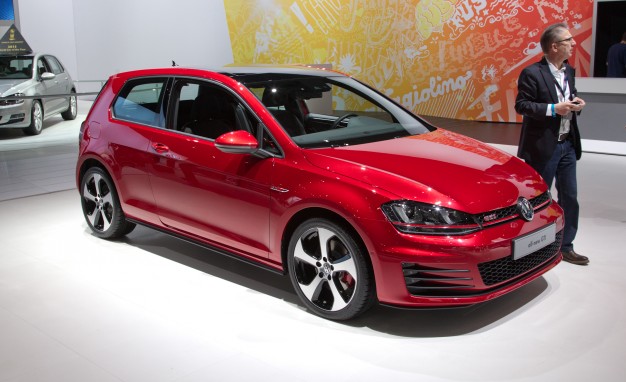
The new “Golf” from the German manufacturer Volkswagen, which began production in Puebla, Mexico in early 2014, was awarded the Car of the Year by the North American International Auto Show in Detroit, Michigan.

Volkswagen’s Golf snagged the North American Car of the Year on Monday, January 12th; arguably the most prestigious award among the many in the auto world, in what was perceived as a surprise win over Ford’s completely redone Mustang.

VW Golf triumphant as "Car of the Year" beating the Ford Mustang and the Hyundai Genesis. (Jonathan Ruiz / El Financiero)
VW Golf triumphant as “Car of the Year” beating the Ford Mustang and the Hyundai Genesis. (Jonathan Ruiz / El Financiero)

The Golf had already won a number of honors this year, but Ford had made quite a splash with the improvements that it made in the Mustang. Even VW officials were caught by surprise.

The finalists for the 2015 Car of the Year award were VW Golf, Ford Mustang, and Hyundai Genesis. The vehicles were judged on Six Car of the Year criteria:
  1. Design
  2. Handling
  3. Innovation
  4. Driver satisfaction
  5. Comfort
  6. Value for money
Individually judging, the Golf won the majority of the votes from 57 jurors.

Volkswagen-Golf-2015

Before coming to North American markets, the new Golf was already sold in overseas markets a year and a half ago. The automaker is also building a production plant in Mexico to supply Golf line vehicles in North America, instead of shipping over the German-made vehicles.

During 2014 59,180 Volkswagen Golf cars were manufactured in Mexico, of which 55,000 were exported mainly to the United States and Canada.

Sources:http://www.elfinanciero.com.mx/

Wednesday, November 26, 2014

México’s German Auto Production Goes from Beetles to Luxury Cars

Mexico’s German auto history began with small, cheap cars. Now it’s becoming a place where top-of- the-line German brands roll out of billion-dollar factories.
Volkswagen ushered in the German auto-production era in México by building Beetles from 1967 to 2003 in the state of Puebla. The cars were once the vehicle of choice for México City taxi companies, with thousands in green-and-white beetles plying the capital’s streets.
According to IHS Automotive consultant Guido Vildozo, by the end of this decade México will claim fourth place worldwide for German luxury output after the carmakers’ home country, China and the U.S.
Earlier this year Bayerische Motoren Werke AG (BMW), the biggest premium-vehicle producer, of the three German marques after Audi and Daimler AG’s Mercedes- Benz, decided to build a plant in México after the Audi and Mercedes-Benz decided in 2012 to build cars in México.
IHS Automotive Managing Director Michael Robinet said, “Mexico has become the crossroads of automotive trade for the western hemisphere.”
The German luxury automakers jumped ahead of some competitors that are still refining strategies for México. In August South Korea’s Kia Motors Corp. announced a more than $1 billion project, while Toyota Motor Corp., the last major automaker without a high-volume México assembly plant, is still studying expansion plans.
Armando Soto, president of Kaso & Asociados, a Mexico City-based auto industry consultant, said that the Mexican factory quality, a surge in engineers and an expanding domestic parts industry all helped pave the way for BMW, Mercedes-Benz and Audi.
“This was quite an easy decision,” Bernhard Eich, the BMW director for the new San Luis Potosi plant, said. “We are very confident we will find the skilled workforce. We have a huge supply network in Mexico.”
(from The Globe and Mail)

Saturday, August 23, 2014

Mexico, Germany see double-digit automotive production increases in May

automotive plantMexico's auto production in May was 297,375 vehicles.

Among the top 10 automotive manufacturing countries, only Mexico and Germany registered double-digit production increases in May. Germany was up 13% and Mexico 11.9.
The leader in automotive production, China, saw its figure drop 13%, while the United States, in No. 2 position, saw a slight rise of 2.1%
The other big automaker in Latin America is Brazil, which saw its production fall 12.2%. Mexico built 297,375 vehicles in May, overtaking Brazil, which built 207,688,  for the No. 7 spot in the world.
What sets Brazil apart from Mexico is the former’s dependence on the domestic market. Nearly all its production is sold internally, while most of Mexico’s is exported to the United States and other countries.
In the first seven months of the year Mexico’s production rose 7.5% over the previous year, with a total of 1.86 million units.
Automotive exports last year were worth $70.6 billion to Mexico and were responsible for 600,000 direct jobs.
The industry could be stronger, say analysts, if the domestic market were healthier. In 2007, Mexicans purchased 1.1 million new, domestically-built vehicles, a figure that has remained more or less unchanged or lower since.
A slight increase has been seen between January and July of this year, with domestic sales up 1.3% to 596,571 units.
Source: El Financiero (sp)
- See more at: http://mexiconewsdaily.com/news/mexico-germany-see-double-digit-automotive-production-increases-may/#sthash.oKOx4y3T.dpuf

Wednesday, August 6, 2014

Mexichem Buys German Chemical Producer for $292 Million

laht.com

MEXICO CITY – Mexican petrochemical firm Mexichem SAB announced on Tuesday the acquisition of Germany’s Vestolit GmbH, a leading European producer of polyvinyl chloride resin, for $292 million (219 million euros) in cash and assumed liabilities.

“The acquisition of Vestolit is in keeping with our strategy of becoming a global, vertically integrated chemical company with a focus on high-end, specialized products,” Mexichem CEO Antonio Carrillo said in a statement.

The deal, which is subject to regulatory approval, is expected to be finalized in the fourth quarter of this year, Mexichem said.

Vestolit is Europe’s only manufacturer of high-impact PVC for applications such as weather-resistant windows.

“This transaction is an opportunity to expand our European footprint, enter a new market segment and acquire new technology,” Carrillo said.

Vestolit’s current management will remain in place, Mexichem said.

Monday, July 21, 2014

Mexico, Germany Form a Binational Commission to Deepen Relations

laht.com

MEXICO CITY – Mexico and Germany have agreed to create a high-level binational commission that will meet on a regular basis to strengthen bilateral relations, Germany’s foreign minister, Frank-Walter Steinmeier, said on Friday.

“We have agreed to form a consultation forum that is going to meet on a regular basis and will act at high-level,” he said.

The German minister, who is on an official visit to Mexico, and his Mexican counterpart, Jose Antonio Meade, agreed in a joint press conference that conditions are ripe to strengthen the trade relationship.

Steinmeier highlighted that it was in the interest of both countries to enhance export opportunities.

“Mexico and Germany are interested in a free, dynamic and open market, free and open international trade, and it is important to strengthen conditions to achieve it,” he added.

Describing Mexico as “a country that builds bridges between the north and the south of America” on many core issues, from the protection of the environment to cyber security, Steinmeier said German businessmen had confidence in the country’s development.

He cited the millions of dollars that carmaker BMW agreed to invest in the country and pointed out that a plant of the German cosmetics firm Beiersdorf will be inaugurated in Silao, in the central state of Guanajuato, on Saturday.

Meade, in turn, said the values shared by both countries “make Germany a strategic partner and ally of Mexico at the global level.”

Germany is Mexico’s most important trading partner in Europe, with trade exceeding $17.2 billion in 2013, as well as one of the chief allies of the Latin American country in global cooperation.

Some 1,700 German companies have investments in Mexico, where they employ more than 120,000 people.

The German minister, who began a two-day visit to Mexico on Friday and was received by president Enrique Peña Nieto, is accompanied by an entourage of businessmen.

Wednesday, March 19, 2014

German company to expand factory

Representatives of the German cable and harness manufacturer Leoni announced an expansion of their factories in Durango on Monday, which they said will create 800 new jobs.
With these new jobs, Leoni, which is considered to be the world’s leading manufacturer of copper wire and automobile cables, will employ a total of 3,000 people in Durango by the end of 2014.
Leoni President Andreas Brand said that the company’s decision to expand its Durango operations is due to the support it has received from Gov. Jorge Herrera Caldera, the quality of the state’s workers and its recent acquisition of an exclusive supply contract with Mercedes Benz.
Brand’s comments were made following a meeting with Herrera Caldera, State Economic Development Secretary Ricardo Navarrete Gómez and Foreign Investment Undersecretary Esteban Rosas.
Herrera Caldera said that he was grateful for the confidence of German investors in his state, adding that he will continue to promote industrial and transportation infrastructure during the rest of his term in office, which he said will make the state’s industries more competitive.
He went on to say that infrastructure projects like the Durango-Mazatlán Superhighway, which was inaugurated last year, have helped reduce operating costs for companies based in Durango and have helped them access domestic and international markets.
THE NEWS

Monday, March 10, 2014

Mexico starred at tourism fair


Mexico’s time in the global tourism spotlight came to an end on Sunday with the closing of the International Tourism Fair (ITB) in Berlin.

Upon the closing of the event, organizers said that $9 billion worth of business deals were made at the fair, a record for the tourism promotion event.

The ITB’s success was largely a product of the large number of exhibitors. Some 10,000 tourism industry companies from 189 countries gave their proposals to more than 114,000 industry professionals and 60,000 members of the general public during the five-day event — a higher turnout than expected.

“The exhibitors and visitors at the ITB in Berlin this year take home with them the spirit of euphoria that was felt during these last five days,” said ITB Director Christian Göke, adding that this year’s fair was centered around issues such as sustainable growth and making reservations via wireless devices.

In recent years, German citizens have had more vacation money due to a stable job market, a rise in collective agreements to regulate salary levels and positive economic growth forecasts. This is one of the reasons that this year’s fair was so important for Mexico, which is trying to diversify its tourist market from its heavy independence on U.S. visitors.

U.S. tourists made up 55 percent of all international visitors to Mexico in 2012, a number which has been steadily rising in recent years. German tourists represented 1.6 percent, a number that Mexican officials and industry professionals are trying to increase.

Mexico’s Ambassador to Germany, Patricia Espinosa Castellanos, said that the fair was an overall success, adding that there is mutual interest from both countries to continue strengthening their relations.

She mentioned that President Enrique Peña Nieto has already held several meetings with German Chancellor Angela Merkel, and that there are conversations being held in preparation for Peña Nieto’s first official visit to Germany.

Wednesday, March 5, 2014

Tourism sec’y meets German lawmakers

Wednesday, 05 March 2014 00:10
BY ROCÍO ZAYAS
The News

Tourism Secretary Claudia Ruiz Massieu met with German lawmakers on Tuesday to work on tourism coordination issues.

She discussed Mexico’s recently-passed economic reforms, assuring them that the country is in movement.
“Mexico is a country with macroeconomic stability, institutional solidity and large growth potential,” Ruiz Massieu said. “This is reflected in the agreements, reforms and consensus between political forces.”

German deputies Jürgen Klimke — who is also president of the Germany-Mexico Group — and Hieke Brehmer — who is also the German Tourism Commission president — recognized the reforms and expressed their willingness to coordinate with Mexican officials on tourism.

Ruiz Massieu said that the combination of structural reforms and increased investments in Mexico will establish a new platform for spurring economic growth. She said that this is why Mexico needs to show other countries in the world that the nation is becoming modern, trustworthy and rich in tourist attractions.

Achieving a greater frequency of flights between Germany and Mexico is one of the most important goals that the Mexican delegation tried to achieve yesterday, and Ruiz Massieu said that this can be achieved through the increased promotion of tourist destinations in Germany.

She added that interest in increasing the amount of regular and charter flights between the two country exists, something that she said would boost sectors of the economy that cater to tourists.

Ruiz Massieu said that 18,900 German tourists visited Mexico in 2013, a 6.6 percent increase on 2012.


Wednesday, February 12, 2014

Meet Mexico’s entire downhill team: A German prince who skis in a mariachi suit

Screen Shot 2014-02-11 at 3.06.58 PM

The Jamaican bobsled team got plenty of attention going into the Sochi Olympics as the return of the ultimate underdog team. But Prince Hubertus of Hohenlohe-Langenburg—the one-man team for Mexico’s downhill skiing competition, puts them to shame when it comes to great Olympic underdog stories.

Nicknamed “The Royal Disaster,” Prince Hubertus is a legitimate Prince of what was formerly a principality of Germany. The son of Prince Alfonso of Hohenlohe-Langenburg and Princess Ira of Fürstenberg, he was born in Mexico, where he still retains citizenship—though he only lived there full-time until he was about four. After that Hubertus’s family moved to Austria and he grew up mostly in Vienna, where he learned to ski.

He might not have been good enough to compete in the Olympics alongside his fellow Austrians—which is where his Mexican citizenship came in handy. At just twenty-two Hohenlohe founded the Mexican Ski Federation and three years later competed in the Winter Olympics in Sarajevo as the sole skier representing the Mexican Olympic Committee.

Over the next 30 years, along with developing a career as a photographer, pop singer, and all kinds of other miscellaneous activities that give him a pretty convincing claim to the mantle of “most interesting man in the world,” Prince Hubertus competed in the Olympics three more times, including in Salt Lake City in 2010, where he was the oldest Olympian at the games, and this year in Sochi, where he’s certainly the oldest again at age 54.


Prince Hubertus might not medal at the Games (he came in 78th and 46th respectively in the two events he competed in in 2010) but he makes his presence known by skiing in this distinctive mariachi body suit:


Prince Hubertus von Hohenlohe2 550x308 Meet Mexicos entire downhill team: A German prince who skis in a mariachi suit
Image: Mexican Olympic Committee


 The prince is fluent in several languages. He also has his own website, which you owe it to yourself to check out.


Tuesday, November 5, 2013

Ambassador toasts unified Germany

Friday, 01 November 2013 00:10

BY THÉRÈSE MARGOLIS
The News


German Ambassador to Mexico Edmund Duckwitz and his wife Joke Duckwitz hosted a reception at their residence last month to mark the 23rd anniversary of that country’s reunification.

“The events that led to the fall of the Berlin Wall and the eventual reunification as a state happened nearly 24 years ago, and are among the most important moments in modern history,” Duckwitz told his guests at the start of the event.

“At that time, practically no one could have imagined the enormous consequences that the fall of the Berlin Wall would have far beyond Germany’s borders.”

Duckwitz went on to say that the peaceful revolution within the then-German Democratic Republic (GDR) in 1989, which led to the destruction of the Berlin Wall and emergence of a new government committed to liberalization, “fulfilled a long awaited dream” not just for Germans, but for many people across Europe.

“A wave of freedom surged across the entire continent and European integration was given a fresh impetus,” he said.

“Many of the states that less than a quarter century ago were separated by an invisible iron curtain are today a fundamental part of the European Union.”

The ambassador also said that despite its recent economic problems, the European Union is “a true story of success and example of what we can all accomplish if we work together.”

“For younger German generations, unification has become something commonplace and normal, and a unified Europe is nothing special for young Europeans,” Duckwitz said.

“But despite outside and sometimes justifiable criticism, we should focus once again on the accomplishments that have been achieved thanks to a unified Europe.”

He added that the still-strong attraction that neighboring states have toward the EU “are not coincidental.”
“Europe, as we know it today, may be a normal phenomenon for many, but it is not a natural one,” Duckwitz said.

“We all have a responsibility to learn from our past, from the period before German unification and the establishment of European Union. We must work together enthusiastically and optimistically to overcome the problems which may arise and to continue developing the European project. Thusly, Europe, with its vast economic potential and exceptional values can continue in the future to play an important role in our global world.”

Duckwitz also spoke about Germany’s bilateral relations with Mexico, which he said were “broad and based on trust” in all fields.

“Germany traditionally enjoys an esteemed reputation in Mexico and Germans are fascinated by this country and its rich culture,” he said.

“Germany is fully committed to Mexico economically, politically and culturally and we have a good and intense two-way political dialogue.”

With a combined two-way trade of more than $17 billion annually and with more than 1,000 German companies with investment in Mexico amounting to capital holdings of more than $3.3 billion since the year 2000, Duckwitz said that there is even closer commercial and economic cooperation slated for the near future.

German companies currently account for 6 percent of Mexico’s Gross Domestic Product, and provide 120,000 jobs to Mexican workers.

Duckwitz likewise pointed out that since Mexican President Enrique Peña Nieto took office late last year, there has been on ongoing exchange of high-level visits.

He mentioned examples of bilateral cooperation in science, technology, academics and culture.
On Aug. 23, 1990, the East German Parliament agreed to formal reunification with West Germany, and on Oct. 3, 1990, the massive European country was reunited as a single nation under the west’s then-Chancellor Helmut Kohl.