Showing posts with label wine. Show all posts

Wednesday, November 19, 2014

Known for Beer & Tequila, Mexican Wine Turning Heads


go to original
banderasnews.com
November 19, 2014
Mexico is a country known more for its gassy lager and tequila than its grapes - but that’s slowly changing. Wines from regions like the 'Valle de Guadalupe,' just a few hours drive south of San Diego, have found their way onto various restaurant wine lists and specialist shops. (Art by Jean-Manuel Duvivier)


What are the world’s most unlikely wine-producing countries? India, Russia, China? It may surprise you to learn that China has one of the world’s largest wine industries, with over 1.2 million acres now planted with vines.
I have touched down in some unusually located vineyards — Brazil springs to mind — so I wasn’t surprised to hear that Mexico has a fast-growing wine industry. What did surprise me, though, was just how old it is. By common consensus, it seems vines were first planted there in the 1530s by Spanish settlers. One estate can trace its lineage back to 1597. Even by European standards, where there are centuries-old châteaux, 450 years is a long time to be in the wine game.
Many people reading this will never have come across Mexican wine. After all, this is a country known more for its gassy lager and tequila than its grapes. But that’s slowly changing, and wines from regions like the Valle de Guadalupe on the Baja California peninsula, a few hours drive south of San Diego, have found their way onto various restaurant wine lists and specialist shops. But not many. Few are exported to Europe and tracking those down is no easy task.
In the spirit of adventure — and if only to taste the oldest wine produced in the Americas — I decided to delve a little deeper.
Mexico’s wine industry is centered around the Valle de Guadalupe, although there are other areas that grow grapes — namely Zacatecas and the Valle de Parras, where internationally recognized varieties such as Cabernet Sauvignon, Tempranillo, Zinfandel, and Chardonnay have been planted.
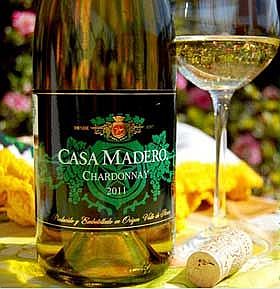
The oldest winery is Casa Madero, which is situated high up in the Valle de Parras. John Worontschak, a UK-based Australian winemaker who has been a consultant to the vineyard since the mid-1990s, says the area’s landscape is akin to a moonscape until you get as high as Casa Madero, where irrigation from the mountain water has created an "oasis of green vineyards."
The estate produces a Chardonnay-Chenin Blanc blend and a Cabernet-Merlot-Tempranillo blend. Both were fairly ripe in character, easy to drink, and well-balanced. Tasted blind, they would be hard to place, although both wines did possess a saline aftertaste, which I had heard was a characteristic — and sometime problem — of these wines.
Rather like South Africa, which can also boast a long winemaking tradition, it’s tricky to work out where Mexican wines sit. Are they New World or Old World? It used to be relatively straightforward to classify. Though wine was first made in the area south of the Black Sea, it was the Europeans who commercialized, cultivated, and then exported it across the world to the so-called New World countries such as Australia, South America, and California. Perhaps we need a new category for those age-old wine-producing countries forging new paths.
Original Story

Friday, October 24, 2014

Mexico’s Burgeoning Wine Scene

online.wsj.com

ENLARGE
JEAN-MANUEL DUVIVIER
WHAT ARE THE WORLD’S most unlikely wine-producing countries? India, Russia, China? It may surprise you to learn that China has one of the world’s largest wine industries, with more than half a million hectares now planted with vines.
I have touched down in some unusually located vineyards—Brazil springs to mind—so I wasn’t surprised to hear that Mexico has a fast-growing wine industry. What did surprise me, though, was just how old it is. By common consensus, it seems vines were first planted there in the 1530s by Spanish settlers. One estate can trace its lineage back to 1597. Even by European standards, where there are centuries-old châteaux, 450 years is a long time to be in the wine game.2009 L.A. CETTO PETITE SIRAH. Mexico’s largest winery, L.A. Cetto is a relative newcomer--it was founded in 1975. Its Petite Sirah is popular in nearby California and, when grown well, it produces a rich wine with ripe red fruit and a soft, smooth feel. Alcohol: 14.5%, Price: £8 or €10

I expect many of you reading this will never have come across Mexican wine. After all, this is a country known more for its gassy lager and tequila than its grapes. But that’s slowly changing, and wines from regions like the Valle de Guadalupe on the Baja California peninsula, a few hours’ drive south of San Diego, have found their way onto various restaurant wine lists and specialist shops. But not many. Few are exported to Europe and tracking those down is no easy task.
In the spirit of adventure—and if only to taste the oldest wine produced in the Americas—I decided to delve a little deeper.
Mexico’s wine industry is centered around the Valle de Guadalupe, although there are other areas that grow grapes—namely Zacatecas and the Valle de Parras, where internationally recognized varieties such as Cabernet Sauvignon, Tempranillo, Zinfandel and Chardonnay have been planted.
The oldest winery is Casa Madero, which is situated high up in the Valle de Parras. John Worontschak, a U.K.-based Australian winemaker who has been a consultant to the vineyard since the mid-1990s, says the area’s landscape is akin to a moonscape until you get as high as Casa Madero, where irrigation from the mountain water has created an “oasis of green vineyards.”
The estate produces a Chardonnay-Chenin Blanc blend and a Cabernet-Merlot-Tempranillo blend. Both were fairly ripe in character, easy to drink and well-balanced. Tasted blind, they would be hard to place, although both wines did possess a saline aftertaste, which I had heard was a characteristic—and sometime problem—of these wines.
Rather like South Africa, which can also boast a long winemaking tradition, it’s tricky to work out where Mexican wines sit. Are they New World or Old World? It used to be relatively straightforward to classify. Though wine was first made in the area south of the Black Sea, it was the Europeans who commercialized, cultivated and then exported it across the world to the so-called New World countries such as Australia, South America and California. Perhaps we need a new category for those age-old wine-producing countries forging new paths.

Sunday, July 27, 2014

Baja California, in Mexico, is wine’s latest ‘next Napa’


By Lettie Teague
THE WALL STREET JOURNAL 

July 25, 2014


Adobe Guadalupe
Wines from Adobe Guadalupe in Baja California’s Valle de Guadalupe.
 
 
Why is it that every obscure but promising wine region is inevitably touted as “the next Napa Valley”? As someone who recently visited one such location, I can attest that this predictive moniker isn’t always totally accurate.

The Valle de Guadalupe is located northeast of the Mexican port city of Ensenada (famous for surfing and fishing), and just two hours from San Diego by car. There are currently about 50 wineries in the region, ranging from slick commercial operations to makeshift structures more like garages. The wine route is marked by contrasts, too — the main ruta del vino, Highway 3, is paved, but many wineries are located far down deeply rutted dirt roads.
Although Mexico’s bottlings are rarely seen in the U.S. — the country’s fine-wine industry is quite young — its wine making dates back to the arrival of the conquistadors, in the 16th century. At one point, production was banned except for liturgical purposes. The modern era of winemaking in the Valle de Guadalupe started some 20 years ago, with the arrival of Hugo D’Acosta, a Bordeaux-educated native of Mexico City who founded his flagship winery, Casa de Piedra, in 1997. Sadly, it had closed for the day at the time of my visit.
Kristin Shute, whose parents, Ray and Patty Magnussen, founded Lechuza Winery in the Valle de Guadalupe in 2005, said D’Acosta was an inspiration to them. While living in California, the couple vacationed in Mexico’s Baja region for many years before deciding to build a winery. Like most producers in this part of the country, the Magnussens focus chiefly on red wines: Cabernet, Tempranillo, Merlot and Nebbiolo, although they make a little Chardonnay as well, in both oaked and unoaked versions.
The unoaked Lechuza Chardonnay was attractive and well-balanced, while the oaked version was dominated by the oak — but I preferred both to the Nebbiolo, which was quite tannic and a bit salty. The saltiness of the wines of the region has been much discussed and is even for many locals a source of pride. But it was an odd characteristic — and one I’d not encountered in a wine. (Many vintners told me they believed it came from the ground water, though some disavowed its presence altogether, calling it instead “minerality.”)

Monday, June 16, 2014

Mexican Vintners Seek Identity as Sales Rise

 laht.com
 
MEXICO CITY – Sales of Mexican wine are growing despite limited government support and the lack of a denomination of origin, thanks to rising interest in winemaking and unique approaches to the business, such as a winery operating on a Mexico City roof.

Guillermo Tame and a group of friends cleared the junk off the roof of a Mexico City building and installed winemaking equipment and built a room to age the product.

“Everyone wanted to participate in the project and contribute something,” Tame told Efe.

The aspiring vintners visited the Guadalupe Valley, an important winemaking region in the northwestern state of Baja California, and gained an appreciation for the “high quality” of Mexican wine, Tame said, adding that the group also learned that Mexico City’s wine culture “was very poor.”

The number of people “with some kind of academic training who want to learn and enjoy other pleasures” is growing in Mexico, vintner Victor Segura said.

Segura is one of the partners in Las Nubes, a winery in Baja California that produces a modest 90,000 bottles annually.

The winery was founded in 2008 in a bid to produce “wines of a certain level,” Segura said.

Mexico must do research to determine which variety of grape can be developed so that a denomination of origin can be attained one day, Segura said.

One of the problems facing Mexico’s wine industry is lack of government support and high taxes, Segura said.

The main training center for aspiring vintners is the Autonomous University of Baja California.

There are 40 slots in each class and the majority of graduates “are making an investment in a vineyard,” the director of the university’s wine program, Laura Alicia Beyliff, said.