Showing posts with label elections. Show all posts

Tuesday, July 8, 2014

Canadians living abroad will be able to cast ballots next June 30 for four byelections — two in Alberta, two in Ontario

yucatantimes.com


Canadians living abroad, regardless of when they left the country, will be able to cast ballots in next week’s federal byelections in Ontario and Alberta.
An Ontario Court of Appeal judge made the ruling today, denying the federal government’s request for a stay of a lower court ruling that would have extended voting rights to anyone who had lived outside the country for more than five years.
Monday’s decision comes just days before voters were to head to the polls on June 30 for four byelections — two in Alberta, two in Ontario.
To grant a stay in this case would … claw back the vote of a citizen who may well in the end have the right to cast her ballot.’— Justice Robert Sharpe, Court of Appeal for Ontario
It paves the way for about 1.4 million longtime Canadian expats to vote alongside others who moved abroad more recently.
An amendment to the Canada Elections Act passed in 1993 barred citizens abroad from voting in Canadian elections if they were out of the country for longer than five years.
But last month, Ontario Superior Court Justice Michael Penny found the five-year rule arbitrary and unconstitutional.
The [government] essentially argues that allowing non-residents to vote is unfair to resident Canadians because resident Canadians live here and are, on a day-to-day basis, subject to Canada’s laws and live with the consequences of Parliament’s decisions,” Penny wrote in the May 2 decision.
I do not find this argument persuasive.”
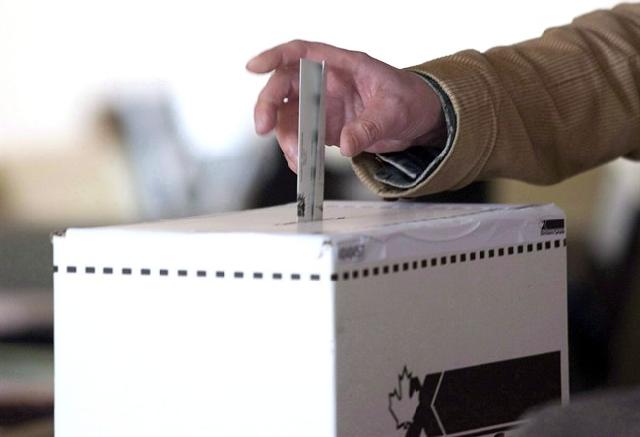
An Ontario Court of Appeal judge on Monday denied the federal Attorney General's request for a stay on a lower court ruling. That earlier ruling had overturned an amendment to the Canada Elections Act only allowing expats to vote in Canadian elections if they had lived out of the country for less than five years. (Chris Young/Canadian Press)
An Ontario Court of Appeal judge on Monday denied the federal Attorney General’s request for a stay on a lower court ruling. That earlier ruling had overturned an amendment to the Canada Elections Act only allowing expats to vote in Canadian elections if they had lived out of the country for less than five years. (Chris Young/Canadian Press)
‘Irreparable harm’ scenario dismissed
In last Monday’s ruling denying the federal government’s request of a stay, Justice Robert Sharpe wrote that while there was “an arguable appeal” from the Attorney General of Canada, “the balance of convenience weights in favour of refusing a stay.”
Sharpe dismissed the government’s argument that it could cause “irreparable harm” if a close election came down to the single vote of a non-resident who, it might turn out, was ineligible to vote. But such a scenario would be “fairly remote,” Sharpe said.
He also reasoned that Elections Canada had already taken administrative steps to allow citizens abroad to vote after the lower court ruling, and it was counterproductive to “undo what [Elections Canada] has already done.”
Only 13 Canadian ex-pats have so far registered to vote since the May decision.
Even so, Sharpe wrote today: “To grant a stay in this case would require Elections Canada to rescind the registrations of up to 13 non-resident electors and claw back the vote of citizens who may well in the end have the right to cast their ballot.”
A total of 131 voters abroad have registered for the four byelections scheduled for June 30.


Tuesday, May 6, 2014

More than one million Canadians living abroad are now eligible to cast ballots in the next federal election

yucatantimes.com
Mon, May 5th, 2014


The voting rights have been restored to all Canadian citizens living abroad as long-term permanent residents in other countries. This court ruling could make a million additional Canadians eligible to vote in the next federal election.
While mass murderers have the right to vote, long-term expats “who care deeply about Canada” do not have the right, Ontario Superior Court Justice Michael Penny said in his decision.
Penny found part of the Canada Elections Act, which bars expatriates who have lived abroad for more than five years from voting, is unconstitutional.
Election Day Prep
Election Day Prep
The [government] essentially argues that allowing non-residents to vote is unfair to resident Canadians because resident Canadians live here and are, on a day-to-day basis, subject to Canada’s laws and live with the consequences of Parliament’s decisions,” Penny wrote.
I do not find this argument persuasive.”
For one thing, Penny ruled, expats may well be subject to Canadian tax and other laws.
The government, the judge found, had decided some citizens are “not worthy” to vote despite their constitutional right to do so.
This is not the lawmakers’ decision to make — the Charter makes this decision for us,” Penny wrote.  Citizenship, he noted, is a fundamental requirement for voting, not residency.
The judge rejected the government’s request to put his decision on hold for 12 months.
Gabrielle Renaud-Mattey, a spokesman for Pierre Poilievre, minister of state for democratic reform, said Sunday the government would review the decision before deciding on any appeal.
“The ruling did not affect the controversial proposed Fair Elections Act”, Renaud Mattey said.
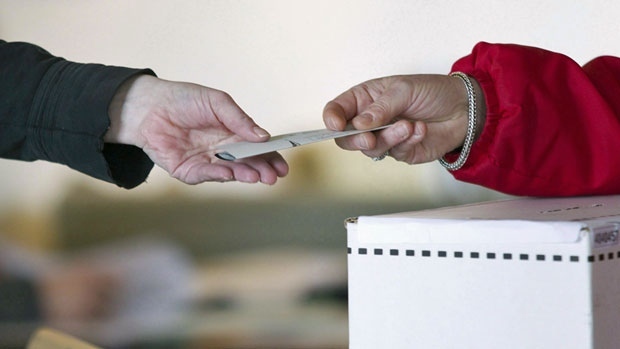
A voter casts a ballot in the 2011 federal election in Toronto on May 2, 2011. THE CANADIAN PRESS/Chris Young
                                     A voter casts a ballot in the 2011 federal election in Toronto on May 2, 2011.                                                            THE CANADIAN PRESS/Chris Young

Strong attachment to Canada
Two Canadians living in the United States launched the constitutional challenge, heard in February, arguing the five-year rule was arbitrary and unreasonable.
Both argued they had only left for educational and employment opportunities and still have a strong attachment to Canada and a stake in its future.
One of the applicants, Montreal-born Jamie Duong, 30, of Ithaca, N.Y., said he was thrilled with Friday’s ruling.
The decision is good for me, good for democracy, and good for Canadians everywhere,” Duong said.
The other applicant, Toronto-born Gillian Frank, 35, of Princeton, N.J., who served in the Canadian military and was a Governor-General’s Award winner, said the ruling had “strengthened our country’s democracy.”
Both said they looked forward to voting in the next election.
The rule disenfranchising Canadians abroad for more than five years was enacted in 1993 amid debate about the strength of their ties to Canada and their knowledge of domestic politics.
However, the five-year clock reset for those who returned even for short visits until 2007, when Elections Canada began enforcing the requirement for expats to “resume residency” in Canada to regain their right to vote abroad if they left again.
The law exempts some long-term expats — among them members of the Armed Forces and diplomats — who can vote by way of a “special” ballot. As many as 1.4 million other Canadians fall afoul of the law, experts estimate.
In all, expats pay an estimated $6 billion in income taxes to the Canadian treasury, despite using fewer resources than their in-country counterparts.
Toronto lawyer Shaun O’Brien — of Cavalluzzo, Hayes, Shilton, McIntyre and Cornish — said she was delighted the court recognized a fundamental democratic right of the expats, who “care deeply about Canada.”