MEXICO CITY – Mexico’s tequila exports rose 16 percent to $568 million in the first half of this year, compared to the same period in 2013, the Agriculture Secretariat said on Wednesday.
Exports were boosted by higher sales of 100 percent agave tequila to markets such as China, Russia and the United States, the secretariat said in its preliminary report.
Mexico exported 149.1 million liters of tequila worth $996.9 million in 2013.
Mexico currently exports tequila to 90 countries, including Australia, Spain, the United States, China, France, Japan, Lithuania, Panama, Britain and Russia, the secretariat, which oversees the Tequila Regulating Council (CRT) said.
The agave used to produce tequila was granted denomination of origin status in 1999 in an area that covers Jalisco, Guanajuato, Michoacan and Tamaulipas states, the secretariat said.
Smoky, unique, and anachronistically artisan, Mezcal is rapidly becoming a go-to spirit for connoisseurs interested in connecting with Mexico’s rustic roots. Although mezcal is typically made from the same espadin agave that is used to produce tequila, mezcaleros (mezcal producers) also use a wide selection of other wild and domesticated varieties of agave. In particular, the tobala agave has found favor with consumers at high-end establishments in Mexico City and even farther abroad. As demand for the spirit grows, however, some local producers in the hills of Oaxaca on Mexico’s southern Pacific coast are starting to worry that the supply of wild tobala agave may soon be exhausted. While the corn, wheat, grapes and potatoes used to produce wine, grappa, pisco, vodka, and whisky and bourbon take a single season to grow, the agave plants used to produce mezcal can take up to two decades to mature. Standing in one of the fields that produces agave for his distillery, Jorge Rodriguez-Cano, a 25-year-old co-owner of the Amores Mezcal brand, peered out a long row of five-foot-tall dark green agave plants. Wispy clouds rolled over the jagged peaks around the valley and the hot summer sun beat down on the green agave plants, which look like gargantuan aloe vera plants, but with tougher leaves and sharp spines. “These are about ten years old,” Rodriguez-Cano explained. A few yards away Cristobal Martinez, a 53-year old farmhand chopped at an agave plant with a long, sharp machete, hacking off the leaves and leaving behind the plants one-foot-tall core, which is called a piña because it looks like a giant pineapple. “Don’t touch the piña, it’s really corrosive,” Rodriguez-Cano warned. “Once I picked up a piece of raw agave and licked it to taste the flavor. I had to spit it out and I couldn’t taste right for six months. The juice is really caustic,” he added. Martinez hacked off the leaves of another plant, one of several dozen he would harvest over the course of the morning. His hands were calloused and scarred after years of working with the agave plants. “I always use long sleeves when I work,” he explained.
Jorge Rodriguez-Cano (right) stands in front of a ten-year-old agave espadin plant at his farm in Oaxaca,
Mexico. Photo by N. Parish Flannery @LatAmLENS
Later in the afternoon, inside the distillery that produces his Mezcal Amores brand, Rodriguez-Cano surveyed the operation, watching a worker guide a horse-pulled, stone, grinding wheel over clumps of roasted, gooey agave. Using similar techniques as a New England clambake or New Zealand hāngi-style seaside barbecue, mezcal producers use a wood-fire pit and stones to create a rustic sort of oven. They place the raw agave on a pile of scalding rocks and smoldering charcoal and then cover the fire pit with leaves and dirt. As is the case with Argentine style coal-roasted onions, during the cooking process the agave goes through a chemical change, caramelizing and transforming into a molten, fibrous pulp that oozes with sweet nectar. Rodriguez-Cano picked up a chunk of roasted agave and sliced off a bite-sized piece. It was sweet and rich, similar in flavor to a candied pumpkin. At small, family-owned distilleries throughout Oaxaca, the cooked agave is fermented in giant open-topped wooden barrels and then distilled in wood-fire copper stills, a process that hasn’t changed since the Spanish introduced it during the colonial era. Rodriguez-Cano looked over a massive pile of raw agave, ready to be fed into the ovens, part of an operation that produces thousands of bottles of clear, smoky mezcal every year. “We also plant our own agave,” Rodriguez-Cano explained. “The idea is reforestation. We want to give back to the community too,” he added.
Higher up in the steep peaks outside of Oaxaca City, a colonial enclave known for its richly preserved architecture and utterly fantastic cuisine, Rodriguez-Cano strained his neck and pointed up towards the hilltop. “That’s a tobala,” he explained gesturing towards a squat plant with wide leaves. Tobala is the wild cousin of the domesticated espadin agave that Mezcal Amores and most other producers use. More complex in flavor and much harder to find, bottles of tobala mezcal can sell for hundreds of pesos in boutique stores in Oaxaca and Mexico City. At a small distillery high up in the mountains, Santos Martinez Cruz, a second-generation mezcalero explained that he and his family produce tobala mezcal. “You have to find them in the hills,” he said. “Each batch takes about 200 piñas,” he added. As iridescent mezcal dripped slowly from his still and the agave pulp steamed in the five foot tall wooden fermentation barrels, Martinez Cruz poured out a glass of tobala mezcal for his visitors to sample. It was dry, smoky, and earthy. As Martinez Cruz explained his family’s history producing mezcal, Beto Adame, a photographer visiting Oaxaca from Mexico City climbed up the hillside and snapped a photo of a small tobala plant. “It’s rugged, bulky… wider than the espadin,” he said.
While espandin agave can be cultivated and produced sustainably, tobala mezcal is more complicated. It is perhaps the most traditional variety of mezcal and the spirit that provides consumers with the most direct connection to the rustic traditions of Oaxaca’s high sierra. Mezcaleros hike up through the steep hills search out and harvesting the wild plant, bring back dozens of piñas to their distilleries. Collectively, each batch of piñas represents an entire epoch of time in the hillside. To put it in perspective, to grow 200 tobala plants to maturation one after another would take 4,000 years. With such a massive gap between the yearly harvest schedule and the decades necessary for the plants to grow, wild agave may be threatened by the recent boom in the mezcal industry. “Tobala is special, but cutting it down to make mezcal is kind of like wearing a panda-fur coat,” Rodriguez-Cano explained.
Although the agave plants feature corrosive juices and razor sharp spines that often break off inside the wound of any unlucky interloper unfortunate enough to step on one, their natural defenses are not likely to provide sufficient protection from mezcaleros keen on profiting from growing interest in tobala mezcal.
While the mezcal boom will provide a much-needed economic stimulus to many families and communities, the industry needs to engage in long-term planning to protect its own future.
“We have to think about sustainability,” Rodriguez-Cano explained.
Terroir. Wild yeasts. Elevation. Who knew these terms could apply to mezcal as easily as to wine. In fact, “the vocabulary of mezcal is more like the vocabulary of wine than spirits,” explains Ron Cooper, the California artist who founded Del Maguey single-village mezcals 20 years ago when the beverage wasn’t on anybody’s radar.
“We’re talking about terroir, about mouth feel,” he says. “We’re talking about aroma, nose.”
He can go on for hours, recounting the long history of mezcal made in remote villages hours off dirt roads.
For Cooper and a growing number of aficionados, mezcal is the very definition of artisanal spirit. Each maker has his signature style and recipe passed down for generations. Unlike tequila, mezcal doesn’t come from a gleaming factory but is made in small batches in primitive copper alembic and sometimes clay pot stills.
“Mezcal is the moonshine of Mexico,” says Raul Yrastorza of the dedicated downtown L.A. mezcal and tequila bar Las Perlas. “From glass to glass, it’s amazing.”
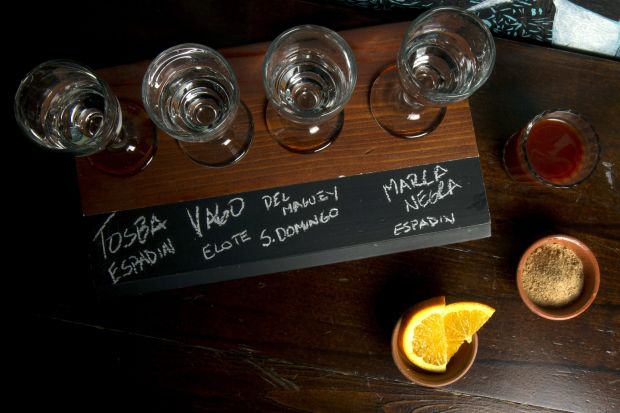
To make his point, Yrastorza offers a flight of four Del Maguey mezcals from four villages at four elevations, from 5,000 feet to 9,000 feet. “For every 300 feet you go in elevation, the more arid the soil, the more stressed the plant gets,” Yrastorza explains. “The wild microbes and yeasts in the air change, so the flavor profile is automatically going to be different. As the plant becomes more stressed, it develops more sugar and the distilled spirit has more complexity.”
The differences between the village mezcals are not subtle, and I stretch to find a vocabulary to describe their flamboyant flavors. I’m drawn to the complex warmth of the Chichicapa and the spice and smoke of San Luis del Rio. Yrastorza’s favorite is the last, from Santo Domingo Albarradas at 9,000 feet. It reminds him of a fine grappa.
Unlike tequila, which is always made from blue agave, mezcal can be made from 28 varieties of the plant, only four of which can be domesticated, though espedin agave is the one that can be cultivated most consistently.
Mezcal gets its characteristic smokiness from the pina, or heart of the plant, which is roasted for three to five days over hot stones in a pit covered with earth. According to Cooper, depending on the village, it’s either mashed in horse-turned stone mills or by men wielding heavy mallets. After fermenting with wild yeasts in wooden vats, the liquid is distilled in wood-fired clay or copper stills.
Tequila makers often steam-cook the agave to speed up the process. When it comes time to distill, that’s like starting with a boiled onion compared to a roasted caramelized onion, Cooper says. “It’s incredible how all the different little ancient technologies can change the flavor.”
Yrastorza pours a second flight of mezcals: Mezcal Vago Elote, Mezcal Tosba, Mezcales de Leyenda “Cupreata” and Mezcalero Release #7 from San Juan del Rio. The first is smooth as silk, infused with roasted corn after the second distillation and before an extra third. The Tosba is more assertive, with a long finish. And the Leyenda presents a wonderful complexity that can be untangled only over the course of an evening. The Mezcalero is sweet and alluring, a blend of three agaves, two of them wild.
At Las Perlas, shelves hold a collection of over 120 bottles. That’s more than twice as many as last year.
New bottles are coming into the market all the time. Open four years now, this gem of a bar used to be one of the few places to stock more than a handful of labels. That’s beginning to change.
“None of this would have happened without Ron Cooper,” Yrastorza says. He says Cooper was the first to commercialize great artisanal mezcals. “There’s a saying: ‘You don’t find mezcal; mezcal finds you.’”

 MEXICO CITY – Mexico’s tequila exports rose 16 percent to $568 million in the first half of this year, compared to the same period in 2013, the Agriculture Secretariat said on Wednesday.