Showing posts with label Michoacan. Show all posts

Thursday, January 29, 2015

Monarch numbers up but not enough

 
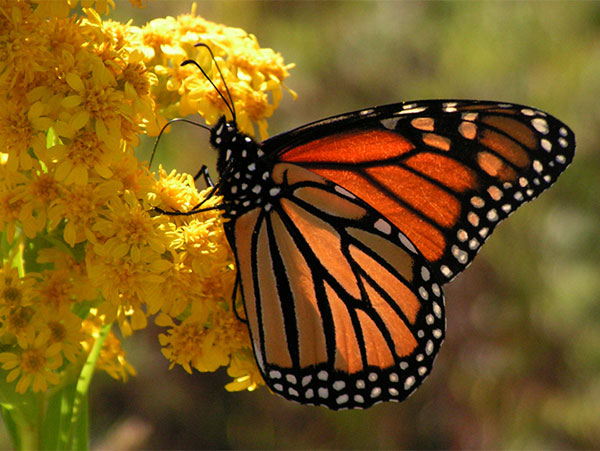
monarch butterfly Millions of monarchs have arrived for the winter.


The monarch butterflies have been counted and the numbers are in: they’re up 69% from last year.
However, that’s still the second-lowest number in 21 years.

The butterflies migrate annually from Canada and the United States — a journey of up to 4,000 kilometers — to spend the winter in the forests of Michoacán and the State of México. But their numbers have been declining.

Last year they covered an area of 0.67 hectares, the lowest since monitoring began in 1993. This year that figure is up to 1.13 hectares. Butterfly numbers are measured in terms of the area they cover — made simpler by the fact that they cluster together on trees. The largest area ever recorded was considerably higher at 18.2 hectares in 1996-97.

An entomologist at Sweet Briar College in Virginia says anything less than two hectares means the butterflies are in danger. Lincoln Brower said four or five hectares would be “a sign of significant recovery.”

The decline in numbers has been attributed to destruction of habitat through illegal logging in Mexico, and the loss of milkweed, their main source of food, in the United States. The logging has been brought under control and efforts are under way in the U.S. to restore milkweed.

But worries remain about the monarch’s future: the U.S Fish and Wildlife Service is investigating whether the butterfly should be classified as endangered.

This year’s migration has brought nine colonies of monarch butterflies, three in Michoacán and six in the State of México. Five of those are inside the Monarch Butterfly Biosphere Reserve. The largest colony covers 0.57 hectares, about half the total, and is located in the ejido, or communal village, of El Rosario.

Visiting the reserve, where ejido residents offer guide services, is popular at this time of the year.

One guide, 73-year-old Audelia at the Sierra Chincua sanctuary in Michoacán, remembers that years ago the butterflies were considered an infestation and there were fears they would dry out the forest.

Sources: La Jornada (sp), El Universal (sp), AP (en)
 
- See more at: http://mexiconewsdaily.com/news/monarch-numbers-not-enough/#sthash.QIUSrg14.dpuf

Friday, January 2, 2015

Monarch numbers appear to be up

monarch butterfly
The monarch butterfly makes Mexico its winter home.


Although it’s still too early to know how many monarch butterflies made the annual migration this year from the United States and Canada, the U.S. Fish and Wildlife Service has decided to go ahead and determine if the insect should be classified as an endangered species.

The director of Mexico’s Monarch Butterfly Biosphere Reserve says the numbers appear to be up this year, although an official census won’t be ready until the middle of this month. “We’re encouraged because we’ve seen more,” Gloria Talavera told the Associated Press on Monday.

But just as the greater numbers show up, another threat comes along: unusual cold temperatures pose another threat to the monarch. The National Meteorological Service has forecast 55 cold fronts until May, up 15% from the average.

The butterflies appear to be aware of the forecast, or have their own system of predicting the weather. Talavera said they are looking for more protected areas, such as canyons, perhaps as a measure to protect themselves from the cold. They also arrived later than normal.

The numbers of monarchs have been down significantly in recent years, a decline that has been attributed to habitat loss through logging in Mexico and fewer milkweed plants, on which the butterflies lay their eggs. University of Chicago ecologist Marcus Kronforst estimates that 1 billion made the Mexico migration in 1996, but barely 35 million did so last year.

The insects are counted by estimating the number of acres they occupy, which was only 0.67 hectares last year. The highest since recording began in 1993 was 18.2 hectares in 1997-97.

Their winter territory in Mexico is found in the State of Mexico and Michoacán, where the butterfly reserve is located.

Sources: AP (en), La Jornada (sp)
 

Tuesday, November 18, 2014

The annual migration of the Monarch butterflies turns the skies orange in Michoacan

theyucatantimes.com

The butterflies are coming, along with an estimated 160,000 visitors close behind.
The annual migration of the Monarch butterflies is on schedule, with an ETA in Michoacán and State of Mexico next week in time for the opening of butterfly sanctuaries, although the early arrivals have already been spotted in those states’ forests.
Despite having made an exceptional journey of 4,000 kilometers or more, they arrive at their winter home “with extraordinary punctuality,” said the National Protected Areas Commission this week.
The butterflies, traveling from the United States and Canada slightly in advance of a two-legged species from the same countries, have already turned skies orange in Saltillo, Monterrey and Ciudad Victoria after beginning to cross the border into Mexico in early October.
Their destination is the Monarch Butterfly Biosphere Reserve where last year they touched down in forested areas totaling 0.67 hectares. As no one has yet developed a reliable system to count millions of butterflies, their numbers are tracked in terms of the area they occupy so as to observe trends over time.
Monarch Butterfly
Monarch Butterfly
Those trends have been downward, resulting in calls for greater protection of their habitat in their northern homes. Last year’s number was 44% less than the previous year.
Next Saturday, various sanctuaries will open to visitors who wish to view the Monarchs and welcome them back. There are so many visitors — 160,000 are expected this season, up rather a lot from last year’s 70,000 — that rules have been introduced to reduce their impact.
Colonies of butterflies — usually between eight and 12 — congregate on trees and although each one weighs but half a gram, branches sag under the combined weight. By clustering in that manner they conserve heat, an important consideration in the often chilly temperatures in the high altitudes of the reserve.
The sanctuaries will remain open to visitors until March, when the Monarchs make the return journey to the U.S. and Canada.

Friday, October 3, 2014

There’s optimism for monarch butterflies

monarch butterfly and milkweedThe monarch and its favorite plant, milkweed.

Reports on the outlook for the monarch butterfly population are mixed, but most researchers seem to agree that Mexico has successfully slowed if not halted the illegal cutting of trees in the Monarch Butterfly Biosphere Reserve.
The number of monarchs that showed up in Mexico last year, after making their 4,000-kilometer journey from the United States or Canada, was down so much that there has been a movement to declare the species endangered.
Deforestation in Mexico has been identified as one cause for the reduced number of monarchs, but another is a severe decline in milkweed plants, considered a weed by farmers who apply pesticides to protect their soy and corn crops.
Trouble is, the monarch butterfly only lays its eggs on milkweed plants.
Last year’s migration to Mexico occupied only 0.67 hectares of forest, 44% less than the previous year and the smallest since 1993 when recording began. The highest recorded was in 1996-97 when 18.2 hectares were covered in millions of butterflies.
The World Wildlife Fund in Mexico puts the blame for lower numbers squarely on the United States. “Mexico has made it a priority to look after the monarch butterfly’s sanctuary,” says Omar Vidal, country director.
“It’s essential that the U.S. and Canada participate as well, but the reality is that we haven’t seen concrete actions on their part.”
However, north of the border not everyone is gloomy about the butterfly’s future, including prominent researcher Karen Oberhauser, whose studies determined that that the reduction in milkweed plants has had a direct effect on butterfly reproduction.
Last month the Monarch Lab at the University of Minnesota, where Oberhauser works, organized a festival to tag and release hundreds of monarchs in order to track their migration routes. More than 1,000 people attended, many of whom had raised the butterflies after lab staff gave away 300 eggs in preparation for the event.
The festival served as an opportunity to educate people about the monarch and how to preserve its habitat. “If everyone does what they can to make sure habitats are healthy, I think the future can look pretty rosy,” said Oberhauser, who has studied the monarch for 30 years.
Another researcher said planting milkweed and native nectar plants could also help the monarchs multiply.
The festival’s organizer, MaryLynn Pulscher, noted that last year’s migration was adversely affected by dry weather. Butterflies sync their migration with the seasons and if the weather doesn’t cooperate, they die, said Monarch Lab staff member Kelly Nail.
Weather will have its effects on monarch populations, but the bigger problem is habitat loss, she said.
Michael Rizo of the U.S. Forest Service was one of those who attended the festival. He said he’s seeing an increasing number of milkweed plants in Minnesota back yards.
Some back-yard plantings might not be considered concrete action, but it’s a start.
Sources: Vanguardia (sp), Minnesota Daily (en)
- See more at: http://mexiconewsdaily.com/news/theres-optimism-monarch-butterfly-outlook/#sthash.PzXYNIIK.dpuf

Tuesday, September 30, 2014

The year’s first monarch butterflies are entering Mexico earlier than usual

 September 29 at 3:08 PM
Despite the dramatic decrease in the number of monarch butterflies in the world, experts in Mexico said last week that there is a tentative sign of hope for the creatures’ mass migration.
The head of Mexico’s nature reserves, Luis Fueyo, said the first butterflies have been seen entering Mexico earlier than usual this year.
Fueyo said it is too early to say whether butterfly numbers will rebound this year from a series of sharp drops — reaching their lowest recorded level in 2013 — but he noted “this premature presence could be the prelude to an increase in the migration.”
He said the first butterflies have been sighted in the northern border state of Coahuila. Most normally arrive in October from the United States and Canada, where they spend the summer.
“This year, we are seeing them present in Mexican territory earlier than usual,” Fueyo said.
By November, they settle in mountaintop forests where they spend the winter. Fueyo said authorities will wait to make a definitive count after the butterflies have settled in completely, something that usually occurs by December.
In February, Mexico, the United States and Canada agreed to form working groups on the conservation of monarch butterflies, after steep and steady declines in the previous three years. Last year, the black-and-orange butterflies covered only 1.65 acres in the pine and fir forests west of Mexico City, down from more than 44.5 acres at their recorded peak in 1996.
Because the butterflies clump together by the thousands in trees, counting individuals is near impossible; instead, they are counted by the area they cover.
The head of international affairs for Mexico’s Environment Department, Enrique Lendo Fuentes, said the three nations “will probably have a joint plan of action before the end of November.”
The plan, experts said, would be to create a corridor of milkweed-friendly areas along the entire three-nation migratory route. That is important, because the butterfly has to reproduce along the way; the same generation doesn’t make the entire trip.
Mexico has already taken a number of steps, such as setting up a network of observers to track monarchs from the time they enter the country, to try to identify milkweed patches that the butterflies might use along their way to their wintering grounds. Activists have launched a Web site where Mexicans can report and share sightings.
Monarchs lay eggs on milkweed leaves; the eggs hatch into caterpillars, morph into chrysalises and transform into butterflies. The butterfly’s dramatic decline is being driven by widespread planting of genetically engineered, herbicide-resistant crops that tend to drastically decrease the amount of milkweed available.
Mexican writer and environmentalist Homero Aridjis said the butterflies face a number of challenges, including climate change and illegal logging in Mexico, in addition to the loss of habitat in the United States.
“We are alarmed, because we don’t yet know what is going to happen” with butterflies, whose migration — but not the existence of the species — is considered at risk of disappearing.
“We don’t know what size population is going to come” to Mexico, “so we are a little alarmed.”