
MEXICO CITY | By David Brunat |
thecorner.eu
“If Mexico is capable of passing its energy reform in a way that enables them to attract foreign investment, it will mean that Canada, United States and Mexico will altogether become the new Middle East in terms of gas and oil production,” U.S. Congressman Henry Cuellar recently said. For some experts the North American country is dealing with its most important political decision of the last century.
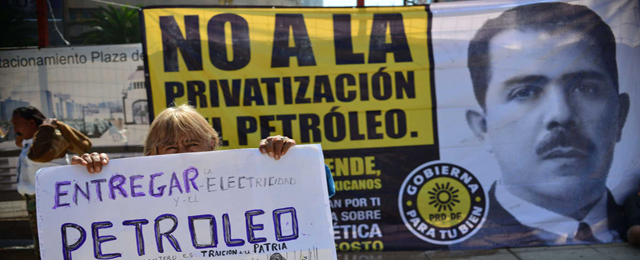
The energy reform is currently discussed by the government and broadly criticized by the opposition and some sectors of the Mexican society. Many people fear Peña Nieto will “sell” the most precious national resource to foreign companies.
But the reality is Mexico needs a step forward. It is one of the world’s Top 10 countries in oil and gas extraction, although recent studies show it may need to import energy as soon as in 2020 due to bad management and extended corruption. While Mexico’s oil production fell 18% in the last 12 years, Brazil increased it 241% and Angola 1,000%, according to FMI figures.
Peña Nieto has promised thousands of millions of dollars in tax revenues and countless new jobs. World’s major oil companies are awaiting the final law to find out their chances to enter such a promising land.
However, experts warn that it is still soon to assert Mexico will become the centre of oil exploration in the next decade.
“Mexican government is strictly talking about shared utility contracts, and limits the whole picture. There will be a public regulator, which will be the only entity with the right of commercialize the oil. That fact increases the risk profile for operators and reduces the attractiveness of the scheme”, explains for The Corner Luis Miguel Labardini, associate for consultancy firm Marcos y Asociados. “Any operator is interested in optimizing the value of its production through its direct participation in the product commercialization, and that wouldn’t be happening here”, continues Labardini.
Oil companies’ interest will also depend on the government take, that is: paying earnings tax. Poland, for example, holds the lower rate with a 30%, while Venezuela, Malaysia and Libya charge 95% in taxes, royalties and all kinds of charges for granting access to their natural resources. In the deep waters of the U.S. side of Gulf of Mexico, Washington charges an average of 64%.
In the end, it will be secondary laws, which are still to be written, the ones that will indicate how open Mexico is to foreign investment. And there is still a year to go before they become public. The last step, the entry of foreign operators to Mexican oil fields, is expected for the beginning of 2015.
*Image: AFP PHOTO/ Yuri CORTEZYURI CORTEZ/AFP/Getty Images
thecorner.eu
“If Mexico is capable of passing its energy reform in a way that enables them to attract foreign investment, it will mean that Canada, United States and Mexico will altogether become the new Middle East in terms of gas and oil production,” U.S. Congressman Henry Cuellar recently said. For some experts the North American country is dealing with its most important political decision of the last century.
The energy reform is currently discussed by the government and broadly criticized by the opposition and some sectors of the Mexican society. Many people fear Peña Nieto will “sell” the most precious national resource to foreign companies.
But the reality is Mexico needs a step forward. It is one of the world’s Top 10 countries in oil and gas extraction, although recent studies show it may need to import energy as soon as in 2020 due to bad management and extended corruption. While Mexico’s oil production fell 18% in the last 12 years, Brazil increased it 241% and Angola 1,000%, according to FMI figures.
Peña Nieto has promised thousands of millions of dollars in tax revenues and countless new jobs. World’s major oil companies are awaiting the final law to find out their chances to enter such a promising land.
However, experts warn that it is still soon to assert Mexico will become the centre of oil exploration in the next decade.
“Mexican government is strictly talking about shared utility contracts, and limits the whole picture. There will be a public regulator, which will be the only entity with the right of commercialize the oil. That fact increases the risk profile for operators and reduces the attractiveness of the scheme”, explains for The Corner Luis Miguel Labardini, associate for consultancy firm Marcos y Asociados. “Any operator is interested in optimizing the value of its production through its direct participation in the product commercialization, and that wouldn’t be happening here”, continues Labardini.
Oil companies’ interest will also depend on the government take, that is: paying earnings tax. Poland, for example, holds the lower rate with a 30%, while Venezuela, Malaysia and Libya charge 95% in taxes, royalties and all kinds of charges for granting access to their natural resources. In the deep waters of the U.S. side of Gulf of Mexico, Washington charges an average of 64%.
In the end, it will be secondary laws, which are still to be written, the ones that will indicate how open Mexico is to foreign investment. And there is still a year to go before they become public. The last step, the entry of foreign operators to Mexican oil fields, is expected for the beginning of 2015.
*Image: AFP PHOTO/ Yuri CORTEZYURI CORTEZ/AFP/Getty Images


No comments:
Post a Comment